DHAKA: Bangladesh’s garment firms re-opened and rushed to complete delayed orders for their Western clients yesterday after an eight-day shutdown caused by the deaths of at least 433 people in a building collapse.
Millions of staff returned to production lines around the capital Dhaka that make clothing for retailers such as Walmart and H&M, which have come under huge pressure to review their contracts in the accident-prone
country.
“All factories have opened today and the workers have returned to work,” said Shahidullah Azim, vice president of the Bangladesh Garments Manufacturers and Exporters Association.
“We don’t have any reports of protests or violence,” he told AFP.
Workers walked out en masse the day the eight-story Rana Plaza compound collapsed in the town of Savar outside Dhaka, the latest in a string of deadly disasters to hit the $ 20 billion
industry.
There has been a series of attacks on factories over the last week, and anger at the conditions of garment workers — many of whom earn less than $ 40 a month — was the main focus of May Day rallies on Wednesday.
Some three million people are employed in the country’s 4,500 textile plants, which are a mainstay of the impoverished nation’s economy. The shutdown is estimated to have cost the industry about $ 25 million a day, according to Azim.
Authorities yesterday suspended the mayor of Savar for approving the building and failing to shut the factories when cracks appeared in the structure a day before the tragedy.
Mohammad Refayet Ullah, who for the last 14 years has been mayor of the satellite town that is home to scores of garment factories, is the highest official to be suspended over the country’s worst industrial disaster.
Local government secretary Abu Alam Shahid Khan told AFP that legal action would be taken against him.
Experts inspecting the site said contractors had used shoddy construction materials and the building had been erected on a filled-up pond in a flagrant violation of construction rules.
The government has also suspended two engineers who approved and cleared the factories to reopen after the cracks appeared in the structure.
They have been arrested along with the building owner and four factory bosses and face charges of causing death due to negligence.
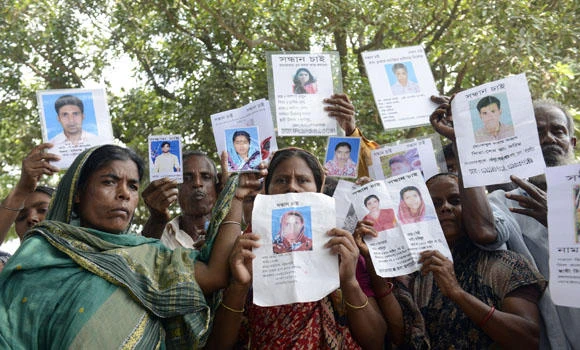
Hundreds of distraught relatives clutching photos of the missing continued to mass at the disaster site as army rescue cranes dug through the mountains of concrete.
Mohammad Helal, a 17-year-old, has been at the site for the last eight days looking for his mother.
“Before leaving for work on the day of disaster, mother told me to be a good boy and look after your younger sisters,” Helal told AFP, wiping tears from his face.
“I know mother won’t be back. But please, I plead with you all, return my mother’s body,” he shouted.
Major General Chowdhury Hassan Suhrawardy yesterday rubbished claims that some bodies were being hidden to lower the body count.
“Some quarters have alleged that bodies are disappearing. They are fuelling public anger by spreading rumour that actual casualties are unbelievably high,” he told reporters in a briefing.
The operation was taking some time as the aim was to recover the bodies without any damage, he said, adding: “We will not move until the last body is found.”
Army spokesman captain Shahid Hasan Bhuiyan told AFP that the confirmed death toll in the disaster was now 433, with 2,437 people rescued.
The overall toll is expected to top 500 as officials said on Wednesday that 149 people were still unaccounted for.
Speaking to Parliament on Tuesday, Prime Minister Sheikh Hasina urged employees to return to work and criticised reported attacks on some factories.
Bangladesh is the world’s second-largest garment exporter after China. The industry accounts for 80 percent of the country’s exports and more than 40 percent of its industrial workforce.
Bangladesh factories reopen to meet Western clients’ demands