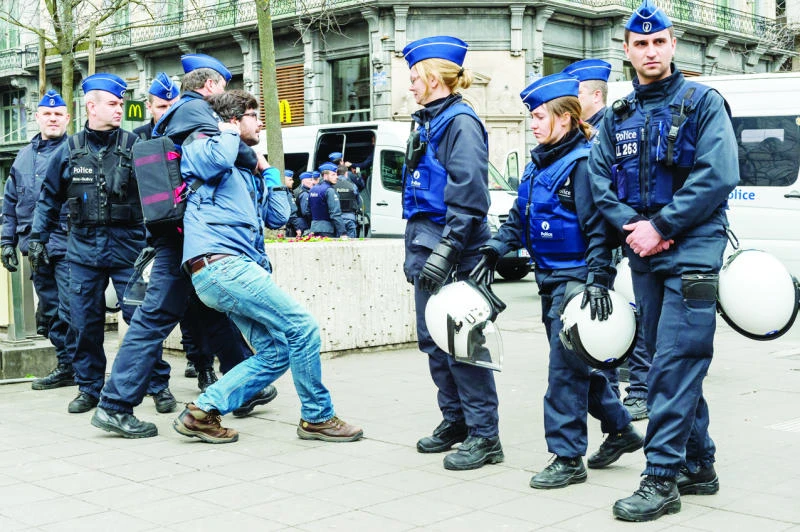
BRUSSELS: Brussels Airport said it will partially reopen on Sunday, 12 days after it was hit by Daesh suicide blasts, as Belgian prosecutors charged a third suspect with terrorism over a foiled plot to attack France.
The first three “symbolic flights” will begin departing from Sunday afternoon, Brussels Airport chief executive Arnaud Feist told reporters, adding that travellers will be subject to additional security checks as police had demanded.
“These flights are the first hopeful sign from an airport that is standing up straight after a cowardly attack,” Feist said.
Passengers will have to make use of a temporary check-in facility as the airport’s departure hall was wrecked in the March 22 blasts that also struck a metro station in Brussels and killed 32 people.
The attacks came just four days after Belgium arrested the prime suspect in last November’s Paris terror assaults and links have emerged between the attackers, exposing a web of cross-border jihadist networks.
European authorities, under pressure to crack down on home-grown extremists, have carried out a number of raids and arrests since then, several of them linked to a foiled plot to attack France. In the latest development in the case, Belgian prosecutors Saturday charged a third suspect with “participation in the activities of a terrorist group” over the plot.
They man was named only as 35-year-old Y.A., who according to Belgian media was arrested in the centre of Brussels on Friday.
The main plot suspect is Reda Kriket, who was arrested near Paris last week after police found an arsenal of weapons and explosives at his home. Paris prosecutor Francois Molins said an imminent act of “extreme violence” had likely been prevented.
A Belgian government official had earlier told The Associated Press things now appeared on track for passenger service to resume at a reduced level on Sunday morning.
Patrick Bontinck, general manager of Visit Brussels, the official municipal tourist organization, said hotel reservations have dropped by half since the March 22 attacks at the airport and the Brussels Metro, meaning a loss of 8,000-10,000 visitors a day to the city that is home to the headquarters of the European Union and US-led NATO alliance, and styles itself as “the capital of Europe.”
One cause for the drop in business, Bontinck said, is the suspension of the 600 daily passenger flights to and from the Brussels Airport, transporting more than 1.5 million passengers in February. But he said there has also been an overall “decline in image” for Belgium’s capital, a popular destination for lovers of beer, chocolate and Flemish art and architecture. The city has been identified in countless international media accounts as a hotbed of radicalism.
Brussels may not be the only capital to be suffering economic consequences from the bloodiest explosion of extremist violence in Belgium since World War II. Bontinck said figures received by his office indicated hotel reservations over the same period dropped 35 percent in Paris, 38 percent in Berlin and 29 percent in London.
“The impact is general,” he said.
TUI Belgium, one of Belgium’s biggest tour operators, said the attacks came at a tough time for the industry: just days before the two-week Easter school vacation.
The company said that it only canceled one flight from Brussels Airport, on the same day two suicide bombers struck the departure hall, killing 16 people. A separate suicide bomber in a Metro train killed another 16 people.
Brussels airport to reopen today with security boost