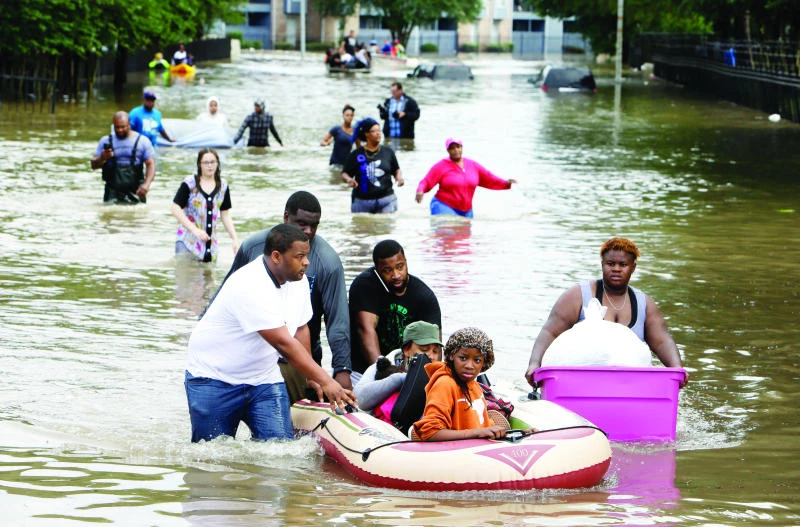
WASHINGTON/HOUSTON: Flooding in and around the US city of Houston has killed at least five people and prompted mass rescues, reports said.
More than a foot of rain deluged the nation’s fourth-largest city, inundating homes, shutting down major highways and leaving five people dead, Houston’s mayor said there was no immediate solution.
Heavy flooding has become nearly an annual rite of passage in the practically sea-level city, where experts have long warned of the potential for catastrophe.
With rain wreaking havoc in the Texas city, the fourth most populous in the country, Gov. Greg Abbott declared a state of disaster in nine counties.
A flash flood watch for Houston will remain in effect until Wednesday morning, with more rain expected Tuesday, the city’s Office of Emergency Management warned.
“I regret anyone whose home is flooded again,” said Sylvester Turner, the city’s mayor, on Monday. “There’s nothing I can say that’s going to ease your frustration. We certainly can’t control the weather.”
“A lot of rain coming in a very short period of time, there’s nothing you can do,” he added.
Rain came down at rates as high as four inches an hour on Monday, the Weather Channel reported, saying some residents were trapped in their homes and cars.
The Houston Chronicle quoted authorities as saying at least five people had lost their lives in the deluge, including a junior high school teacher.
Officials in Harris County said more than 1,200 high water rescues had been carried out, including nearly 900 within Houston city limits, the newspaper reported.
CNN broadcast footage of cars partially engulfed on roadways that had turned into swollen rivers.
In one scene, a man is seen scrambling out of his car and swimming to safety through murky water on a submerged roadway just shortly before his car sinks and disappears from view.
Houston International Airport experienced its second wettest day ever recorded on Monday, the National Weather Service for Houston/Galveston said on Twitter.
Flash flooding and more rain are possible Tuesday, a day after some areas saw water levels approaching 20 inches. Scores of subdivisions flooded, schools were closed, and power was knocked out to thousands of residents who were urged to shelter in place.
In addition to its location, Houston’s “gumbo” soft soil, fast-growing population and building boom that has turned empty pastures into housing developments all over the city’s suburbs and exurbs make it vulnerable to high waters, experts say.
Harris County, where Houston and many of its suburbs are located, has seen a 30 percent jump in population since 2000. Its surrounding counties have almost grown more than 10 percent since 2000, according to the Greater Houston Partnership, a business group.
Some of the resulting developments include adequate greenspace for water runoff, but not all of them do, said Philip Bedient, an engineering professor at Rice University.
“Could we have engineered our way out of this?” Bedient said. “Only if we started talking about alterations 35 or 40 years ago.”
Samuel Brody, director of the Environmental Planning & Sustainability Research Unit at Texas A&M University, last year called Houston “the No. 1 city in America to be injured and die in a flood.”
Rainstorms last year over Memorial Day weekend caused major flooding that required authorities to rescue 20 people, most of them drivers, from high water. Drivers abandoned at least 2,500 vehicles, and more than 1,000 homes were damaged in the rain.
The year before, flash flooding in Houston and suburban counties left cars trapped on major highways.
Those storms still pale in comparison to the devastation wreaked by Hurricane Ike in 2008 and Tropical Storm Allison in 2001. Allison left behind $5 billion in damages and flooded parts of downtown and the Texas Medical Center, which sits near the Brays Bayou, a key watershed.
Bedient has worked with the Texas Medical Center on better preparing its facilities for massive rainfall, including the use of a sophisticated weather alert system that gives the medical center extra time to activate gates and doors that block excess rainwater.
Deadly flood leaves 5 dead in Texas