DALLAS: The first person diagnosed with Ebola in the United States, Thomas Eric Duncan, died on Wednesday morning at a Dallas hospital, a hospital spokesman said.
“It is with profound sadness and heartfelt disappointment that we must inform you of the death of Thomas Eric Duncan this morning at 7:51 am,” hospital spokesman Wendell Watson said in an e-mailed statement.
Duncan became ill after arriving in the Texas City from the West African country of Liberia on Sept. 20 to visit family, heightening concerns the world’s worst Ebola outbreak on record could spread in the United States.
Meanwhile, travelers arriving in the United Stated from Ebola-stricken Liberia, Sierra Leone and Guinea will face mandatory screening measures for the deadly virus as soon as this weekend, according to a media report on Wednesday.
The additional screening could also be extended to passengers from other nations struggling with the outbreak, CNN reported, citing the US government.
Countries in West Africa, where the deadly Ebola outbreak is centered, are already supposed to screen passengers before they are allowed to depart. But, under the new measures, such travelers will also have to answer questions and have their temperature taken with a hand-held scanner once they arrive in the United States, CNN said.
Meanwhile, the first American flown back to the US for treatment of Ebola this summer has donated blood to the most recent one to return from West Africa with the disease.
The Nebraska Medical Center said Wednesday that it called Dr. Kent Brantly on Tuesday to tell him his blood type matches that of Ashoka Mukpo, a freelance video journalist who arrived at the medical center Monday.
The hospital says Brantly was driving through Kansas City, Missouri, and was able to give blood locally that was flown to Omaha. It says Mukpo will receive the transfusion Wednesday.
Such transfusions are believed to help Ebola patients because a survivor’s blood contains antibodies to fight the disease.
Brantly also donated blood to the first Ebola patient treated at the Nebraska hospital.
In Spain, animal rights activists have scuffled with police as they tried to stop health workers from entering an apartment complex where they plan to remove the dog of a nursing assistant infected with Ebola so the pet can be killed.
Firefighters and workers in hazardous materials suits were seen Wednesday inside the complex, and photographers captured images of the mixed breed dog named Excalibur on the balcony of the nursing assistant’s apartment.
Madrid’s regional government got a court order to euthanize the dog, saying “available scientific” information can’t rule out “risk of contagion.” Authorities didn’t say when the dog would be taken away. Workers will also disinfect the apartment.
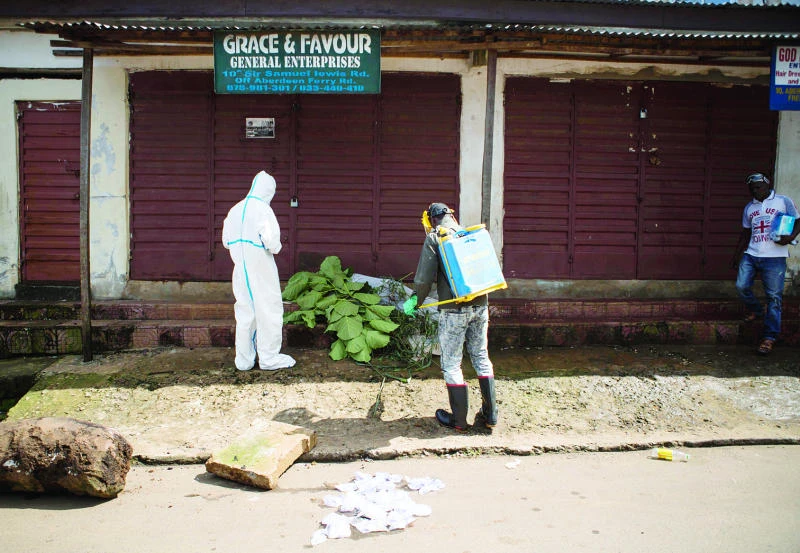
Spanish health officials were investigating Wednesday whether a nursing assistant infected with Ebola got the deadly disease by touching her face with Ebola-tainted protective gloves, while a strike by Ebola burial teams in Sierra Leone left abandoned bodies in the streets of the capital.
More than 3,400 people have been killed by the Ebola outbreak in West Africa, which has hit Sierra Leone, Guinea and Liberia hardest. The case of Spanish nursing assistant Teresa Romero has shown that health workers can contact Ebola even in highly sophisticated medical centers in Europe.
In Madrid, Dr. German Ramirez of the Carlos III hospital said Romero remembers she once touched her face with the gloves after leaving the quarantine room where an Ebola victim was being treated.
Eric Duncan, first Ebola patient diagnosed in US, dies