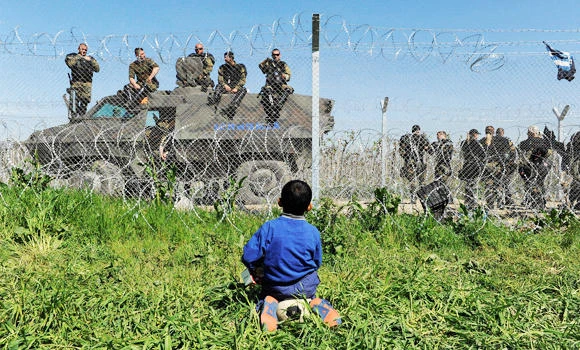
IDOMENI: Greece was stepping up efforts Tuesday to persuade hundreds of migrants to leave a squalid camp on its border with Macedonia where violence broke out at the weekend, officials said.
At least 400 people had agreed to leave in the last two days, local police and an AFP journalist said.
“We can see more refugees are interested in leaving Idomeni. They don’t feel comfortable here, they don’t feel safe here, not at all anymore after the recent events,” said Liene Veide, the UN refugee agency spokeswoman in Idomeni.
On Sunday, some 250 refugees and migrants were hurt as they tried to force their way into Macedonia, with Macedonian riot police firing tear gas and rubber bullets to push them back.
Macedonia accused Greek police of failing to intervene as around 3,000 people “violently” tried to cross the border, hurling stones and injuring police, but Athens said Skopje had used “excessive force.”
The clash was the latest unrest to erupt at Idomeni, where more than 11,000 people have been living in squalid conditions for weeks after Macedonia and other Balkan states barred passage to them. Many of them are refugees fleeing war in Syria and Iraq.
Sunday’s violence broke out after Arabic-language leaflets distributed around the camp falsely suggested the border was about to open.
Greek Prime Minister Alexis Tsipras on Monday blamed non-Greek volunteers for “inciting” migrants to storm the fence.
Veide said the flyers were “everywhere”.
“We don’t have any information who is exactly doing that, but definitely it’s not the solution in this situation,” she told AFP.
Greek police on Tuesday detained for questioning over a dozen volunteers before releasing most of them without charge.
Efforts are also under way to peacefully clear another makeshift camp at the port of Piraeus housing some 5,000 people.
Around 1,000 of them agreed on Monday to relocate to a nearby camp at the industrial hub of Skaramangas.While a controversial deal between the EU and Turkey is reducing the influx into Greece, more than 11,000 people are stuck at Idomeni.
There are also fears that efforts to shut down the Turkey-Greece route could encourage migrants to attempt to reach Europe via the even more dangerous crossing from Libya to Italy, with the Italian coast guard rescuing 1,850 migrants on Monday.
Sunday’s clashes were the latest unrest to erupt at Idomeni, where grim living conditions have made it a symbol of the misery faced by thousands who have fled war and poverty to reach Europe, many of them refugees fleeing war in Syria and Iraq.
Greek police minister Nikos Toskas warned that violence against migrants could fuel religious extremism.
“Those beaten yesterday are the jihadists of tomorrow if we are not careful,” Toskas told Skai radio.
Macedonia has hit back, denying that it used rubber bullets against migrants and accusing Greek police of failing to intervene as around 3,000 people “violently” tried to cross the border, hurling stones and injuring police.
But medical charity Doctors Without Borders (MSF) said it treated around 30 people for injuries from rubber bullets — three of them children under 10 — along with 200 suffering breathing problems and 30 with other injuries.
Greek efforts to move the huge crowds from the squalid encampment at Idomeni into nearby reception centers have so far been unsuccessful.
German Chancellor Angela Merkel’s spokesman Steffen Seibert said Berlin was watching developments there “with concern” and urged all states to ensure border security was strictly in line with human rights.
He urged migrants to move into Greece’s official shelters and to stop attempting illegal border crossings, saying this was “not a hopeful option.”
The European Commission has also called for the people blocked at Idomeni to be relocated, with spokeswoman Mina Andreeva warning them not to push ahead with “a dangerous and irregular onward journey.”
Greece steps up efforts to evacuate migrant camp