WASHINGTON: Defense Secretary Chuck Hagel has approved a recommendation by military leaders that all US troops returning from Ebola response missions in West Africa be kept in supervised isolation for 21 days.
The move goes beyond precautions recommended by the Obama administration for civilians, although President Barack Obama has made clear he feels the military’s situation is different from that of civilians, in part because troops are not in West Africa by choice.
Hagel on Wednesday approved the recommendation sent to him by Army Gen. Martin Dempsey, chairman of the Joint Chiefs of Staff.
Just over 1,000 US troops in Liberia and Senegal are there supporting efforts to combat the virus.
The Army, acting on its own, put a small number of returning soldiers on a 21-day quarantine earlier this week.
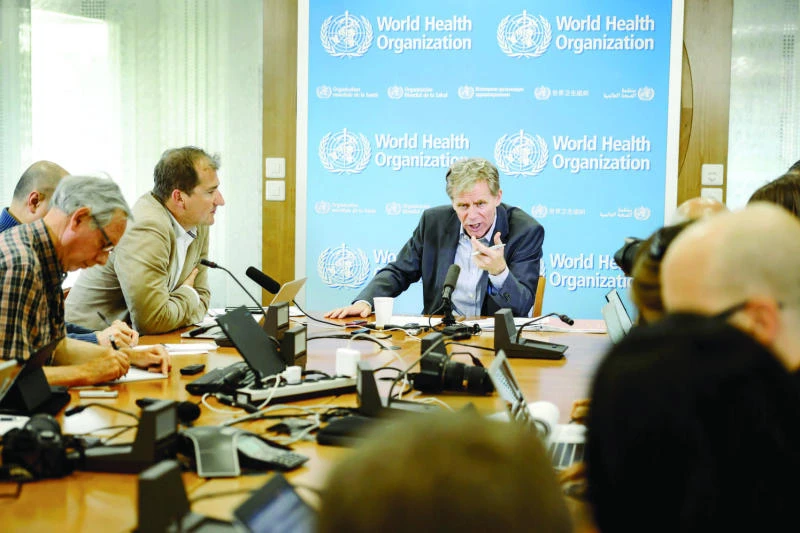
Meanwhile, the rate of new Ebola infections in Liberia appears to be declining and could represent a real trend, the World Health Organization said Wednesday, but the epidemic is far from over.
There are empty beds in treatment centers and the number of burials in the country has declined, Dr. Bruce Aylward, the assistant director-general for WHO, told reporters. He said there may be as much as a 25 percent week-on-week reduction in cases in Liberia. But experts are still trying to ensure their data is reliable.
Throughout the Ebola outbreak, WHO has warned that its data have been incomplete and the number of cases are likely vastly under-reported. That is still a concern, Aylward said, but the trend nonetheless appears to be real.
So far, more than 13,600 people have been sickened in the outbreak, which has hit Liberia, Guinea and Sierra Leone hardest.
“The epidemic (in Liberia) may be slowing down,” he said. But he cautioned: “A slight decline in cases in a few days versus getting this thing closed out is a completely different ball game.” Liberia’s Red Cross said Tuesday that teams collected 117 bodies last week from the county that includes Monrovia, down from the high of 315 in September.
Benoit Carpentier, a spokesman for the International Federation of the Red Cross, warned that it was too early to celebrate those numbers, saying Ebola outbreaks come in waves. He noted that Red Cross figures show deaths are still increasing outside Monrovia.
President Barack Obama is surrounding himself with health care workers battling Ebola in Africa to showcase what he calls their “incredible heroism.” Amid debate over how returning health care workers should be monitored, Obama plans to make remarks from the White House Wednesday afternoon with those who have been to Africa or are about to go there.
The president is being introduced by Dr. Kent Brantly, who was infected with Ebola while working in Liberia and was successfully treated in the United States.
Obama says he wants to encourage the workers and make sure that US policies are based on their experience and science.
Obama also plans to meet earlier in the secure Situation Room with his public health and national security teams on the government’s Ebola response.
Kaci Hickox, a US nurse who has tested negative for Ebola after returning from West Africa, on Wednesday said she would challenge Maine’s restrictions and did not plan to follow guidelines to quarantine herself until Nov. 10.
“If the restrictions placed on me by the state of Maine are not lifted by Thursday morning, I will go to court to fight for my freedom,” she said in an interview on NBC’s “Today” program.
In several media interviews, Hickox said she was in good health and had not had any symptoms of the virus that signal a period when an infected person would be contagious. Speaking from her home in Fort Kent, Maine, she said she had been monitoring her condition and taking her temperature twice a day.
But she sharply criticized state guidelines that would require her to stay isolated at home for 21 days, saying she was “appalled” at restrictions she deemed unconstitutional and not based on science.
“I don’t plan on sticking to the guidelines,” she told NBC.
Lawyers for Hickox told ABC and NBC that Maine officials would have to go to court to get an order to enforce a quarantine and that, if the state does, their client would challenge it.
Hickox worked with the medical organization Doctors Without Borders to help treat patients with the virus in Sierra Leone and fought earlier isolation in New Jersey.
“I feel absolutely great,” she told ABC’s “Good Morning America” program. “I am completely symptom-free.”
Hagel approves 21-day Ebola quarantine for troops