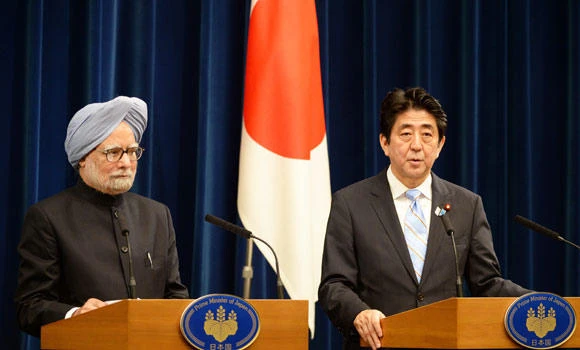
TOKYO: Japanese Prime Minister Shinzo Abe and his Indian counterpart agreed yesterday to speed up talks on a deal to allow Japan to export nuclear plants and to strengthen security cooperation as both sides keep a wary eye on China’s military clout.
The Indo-Japanese summit meeting follows Chinese Premier Li Keqiang’s visit last week to India, which has been shaken by a recent border spat with China and is cautious about Beijing’s friendship with rival Pakistan.
Japan, for its part, has been locked in a territorial dispute with China over a group of East China Sea islets.
“In the political and security area, maritime security cooperation will further be strengthened ... On civil nuclear cooperation, negotiation will be accelerated toward the early conclusion of the agreement,” Abe told a ceremony alongside India’s Manmohan Singh.
Unable to rely on a coal sector crippled by supply shortages and mired in scandals, India is pushing ahead with constructing nuclear reactors despite global jitters over safety. Hundreds of millions of Indians still live without power and factories suffer frequent blackouts.
A civil nuclear energy pact with India would give Japanese nuclear technology firms access to India’s fast-growing market when they search for opportunities overseas to offset an anti-nuclear backlash at home in response to the Fukushima radiation crisis.
India operates 20 mostly small reactors at six sites with a capacity of 4,780 MW, or 2 percent of its total power capacity, according to the Nuclear Power Corporation of India Limited. New Delhi hopes to lift its nuclear capacity to 63,000 MW by 2032 by adding nearly 30 reactors.
Abe and Singh welcomed expanding defense cooperation and decided to hold regular joint naval exercises. The first such exercise was held last June.