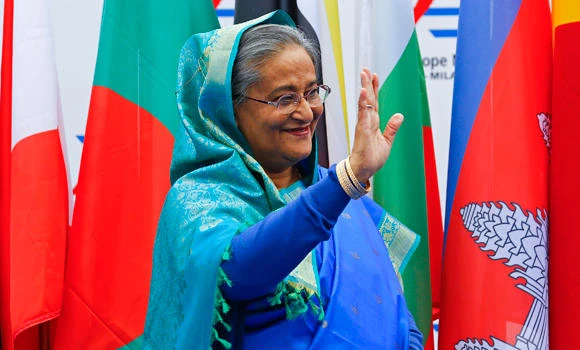
NEW DELHI: India’s top counter-terrorism agency has uncovered a suspected plot by a banned militant group to assassinate the prime minister of Bangladesh and carry out a coup, three senior Indian security officials said on Tuesday.
India will hand over a dossier to Bangladesh with details of the plan by members of the Jamaat-ul-Mujahideen, which has carried out scores of attacks in India’s eastern neighbor, the government and police officials said.
Bangladesh did not comment directly on the assertions that Prime Minister Sheikh Hasina had been the target of a plot, but said it had tightened security on the border with India.
The alleged conspiracy was discovered after two members of the group were killed in an explosion while building homemade bombs at a house in West Bengal in eastern India earlier this month. Indian police say the militants were Bangladeshis and were using India as a safe haven to plan the attacks.
“The strategy was to hit the political leaders of the country and demolish the democratic infrastructure of Bangladesh,” said a senior Indian Home (interior) Ministry official, who spoke on condition of anonymity.
“This was all being planned on Indian soil and we could have been blamed if there was an attack.”
Nizami’s fate to be
decided today
Bangladesh’s war crimes court is set to deliver a long-awaited verdict on the leader of the largest Islamist party, the prosecutor said Tuesday, amid fears it will trigger violence from supporters.
Motiur Rahman Nizami, 71, could face the death penalty if convicted on Wednesday of 16 charges including genocide, rape and arson allegedly carried out during the 1971 war of independence.
The verdict, originally scheduled for June, was postponed at the 11th hour because of a sudden deterioration in Nizami’s health.
“We are finally going to get the long-waited verdict tomorrow,” prosecutor Tureen Afroz said. “We hope he will be sentenced to death for his crimes during the war.”
Nizami is suspected of leading one of the war’s most notorious militias, which allegedly killed top intellectuals as it became clear the new nation of Bangladesh would emerge from what was then East Pakistan.
Deputy commissioner of Dhaka police Abdul Baten told AFP security has been tightened in the capital with extra police deployed.
Authorities fear a death sentence could trigger violent protests by Nizami’s Jamaat-e-Islami party, which has hundreds of thousands of activists and other supporters.
“We won’t tolerate any attempt to create instability or chaos,” junior home minister Asaduzzaman Khan told reporters.
Other verdicts as well as the execution of a senior Jamaat leader last year plunged the country into one of its worst crises as Islamists battled security forces, leaving around 200 people dead.
Nizami, the president of Jamaat, is already on death row after being sentenced to hang in January for trafficking a huge cache of weapons and trying to ship them to a rebel group in northeast India.
Since it was created in 2010 by the government of Prime Minister Sheikh Hasina, the war crimes court has sentenced around a dozen opposition leaders for war crimes.
Islamists accuse the government of using the court to target opposition leaders.
But Hasina’s secular government maintains the trials are needed to heal the wounds of the conflict that it says left three million people dead.
Independent researchers estimate that between 300,000 and 500,000 people died.
Rights groups have criticized the court, saying it falls short of international standards.
India uncovers suspected plot to assassinate Bangladeshi PM