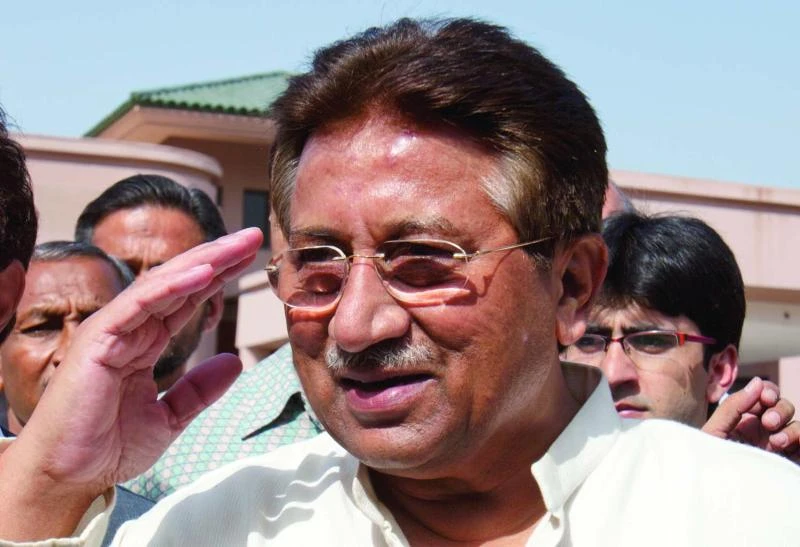
ISLAMABAD: A judge granted bail to Pakistan’s former military ruler yesterday in a case related to the assassination of ex-Prime Minister Benazir Bhutto, his lawyer said.
Despite the bail, retired Gen. Pervez Musharraf will remain under house arrest on the outskirts of the capital, Islamabad, in connection with two other cases against him, including one related to his decision to sack senior judges while in power.
The bail comes days after the lawyer who filed the judges case against Musharraf, Mohammad Aslam Ghumman, said he had decided not to testify against the former military strongman for the sake of “national interest.” Ghumman’s decision has fueled speculation that Musharraf may be allowed to leave the country before the new government led by former Prime Minister Nawaz Sharif takes power in early June. The bail in the Bhutto case could intensify that speculation.
Even though Sharif has a bone to pick with Musharraf for toppling him in a coup, many diplomats and officials doubt he would want to begin his third stint as prime minister with such a prickly issue, especially since it could spark conflict with the army. Musharraf was serving as army chief when he seized power.
But it’s unclear how Musharraf would be allowed to leave legally given the cases against him. There is significant anger against him in the legal community because of his decision to fire senior judges, including the chief justice, while in power.
A judge set Musharraf’s bail in the Bhutto murder case at about $ 20,000 yesterday, said one of his lawyers, Salman Safdar. Musharraf had arranged pre-arrest bail in the case before he returned to Pakistan, but it was canceled in April when his lawyer failed to show up to argue for an extension.
Government prosecutors have accused Musharraf of being involved in the gun and suicide attack that killed Bhutto in 2007 when he was in power. They have also blamed him for not providing the former premier with enough security.
Musharraf has denied the allegations and claimed they were politically motivated. He has blamed the Pakistani Taleban for the attack.
Big win for PTI
The vote was marred by allegations of vote rigging by various politicians, including former cricket star Imran Khan. In response, the election commission decided to repeat the vote or do a recount for eight of the 272 directly-elected national assembly seats.
A candidate from Khan’s Pakistan Tehreek-e-Insaf party, Arif Alvi, won a national assembly seat from a repeat election held in the southern city of Karachi on Sunday, said the judge presiding over the vote, Shahid Shafique. Alvi won over 77,000 votes, more than twice as many as the candidate from the Muttahida Quami Movement who came in second.
The vote in Karachi followed the shooting death of a senior female member of Khan’s party on Saturday night. Khan blamed Muttahida Quami Movement for the killing, but the party denied the allegations.
Furious members of the Muttahida Quami Movement (MQM) have denied responsibility for the killing of Zara Shahid Hussain on Saturday outside her home in the upscale Defense area of Karachi, capping a bloody election in which about 150 people were killed nationwide.
MQM leaders condemned the killing by unidentified gunman and demanded a retraction from Khan.
Also yesterday, gunmen killed a policeman who was guarding a polio vaccination team in Pakistan’s northwest Bajur tribal area, said local government administrator Faramosh Khan.
No one has claimed responsibility for the shooting, but suspicion will likely fall on militants suspected in similar attacks. Militants have accused the polio workers of being US spies and claimed the vaccine is intended to make Muslim children sterile.
Power blackouts
Two Pakistani ministers in charge of water and power explained what can be done to end power cuts of up to 20 hours a day in parts of the country enduring temperatures of 40 degrees Celsius and above — absolutely nothing, it seems, except raise prices.
The power shortages have sparked violent protests and crippled key industries, costing hundreds of thousands of jobs in a country already beset by high unemployment, a failing economy, widespread poverty and a Taleban insurgency.
The “load-shedding” means many families cannot pump water, let alone run air-conditioners, with a disastrous knock-on effect on health and domestic life.
Ministers Musadiq Malik and Sohail Wajahat Siddiqui “expressed their inability to overcome the crisis,” the Daily Times quoted them as telling a news conference in Lahore, where the temperature was 40 C (104 degrees Fahrenheit) yesterday.
“They have termed financial constraints as a major, and incompetence as a minor, hurdle in resolving the issue,” the newspaper said.
“Presenting the realistic picture, the ministers announced that they were going to increase the price of electricity and gas for all sectors.” They gave no details but said the problem would get worse before it gets better.
About two-thirds of Pakistan’s energy is generated by oil and gas and there are widespread gas shortages, with cars run by CNG, compressed natural gas, queuing up for hours overnight to fill their tanks.