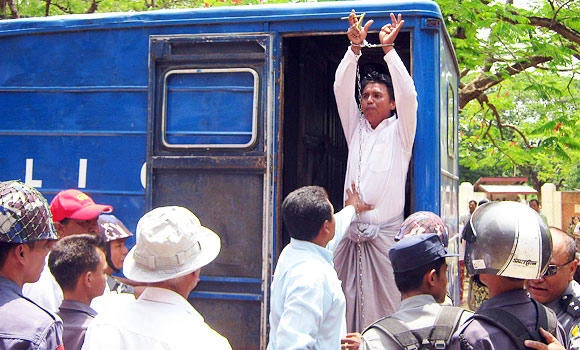
MEIKHTILA, Myanmar: A Myanmar court sentenced seven Muslims to prison yesterday — one of them to a life term — in the killing of a Buddhist monk amid deadly sectarian violence that was overwhelmingly directed against minority Muslims but has not led to any criminal trials against members of the country’s Buddhist majority.
As the country tries to rebuild democracy after decades of military rule, the issue poses a dilemma for politicians who would lose support if they embraced justice for the unpopular Muslim minority. Opposition leader Aung San Suu Kyi, who spent years under house arrest under the former ruling junta but now hopes to bring her party to power, spoke of the law but not of sectarian tensions when asked about the verdict.
At least 44 people were killed and 12,000 displaced, most of them Muslim, in more than a week of conflicts with Buddhists that began March 20 in the central Myanmar city of Meikhtila. A dispute at a Muslim-owned gold shop triggered rioting by Buddhists and retaliation by their Muslim targets, and the lynching of the monk after the gold shop was sacked enflamed passions, leading to large-scale violence.
While the violence is now contained, questions are arising over whether minority Muslims can find justice in overwhelmingly Buddhist Myanmar. Hundreds more Muslims have been killed, and tens of thousands have been made homeless, in violence across the country over the past year.
The sectarian strife has tarnished the image of Suu Kyi, a Nobel Peace laureate who has been criticized for failing to speak out strongly in defense of the country’s Muslims despite her long commitment to human rights. Her supporters, especially abroad, fear she is afraid to take a politically unpopular stand now that her party will mount a bid for power in the next general election in 2015. Prejudice against Muslims is widespread in Myanmar, and it is hard to find public figures willing to speak in defense of the Muslim community.
In a press conference yesterday in the capital, Naypyitaw, she did not directly address the plight of the Muslim minority. Instead, she spoke in familiar terms about the rule of law when asked about the verdict.
“There is no transparency in Myanmar’s justice system and there is too much influence from the administrative branch,” she said, echoing the opinions of many human rights groups. “The judicial system has to be independent to be credible.”
Suu Kyi has been criticized for failing to take a strong stand on attacks last year against the Muslim Rohingya community in western Rakhine state. Mobs of Buddhists armed with machetes razed thousands of homes, leaving hundreds dead and forcing 125,000 people, mostly Muslims, to flee,
When asked whether she was concerned about her reputation over the issue, she said she wasn’t worried. “If I had to be concerned about my image, I should not have become a politician right from the beginning,” she said.
The issue of ethnic strife also marred this week’s Washington trip by President Thein Sein, a trip otherwise filled with accolades for the first leader of Myanmar to visit the White House in 47 years.
Myanmar Muslims jailed for killing Buddhist monk