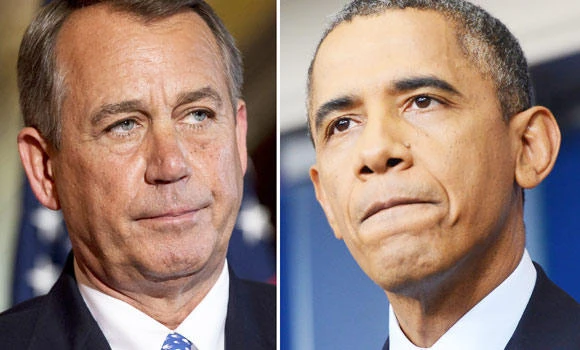
WASHINGTON: President Barack Obama and John Boehner, the top Republican in Congress, are pressuring each other to open the way for votes to end the government shutdown and raise the federal debt limit. Neither side was showing signs of capitulating even with a potential economy-shaking federal default edging ever closer.
Republicans were demanding talks on deficit reduction and Obama’s 2010 health care overhaul law as the price for boosting the government’s borrowing authority and returning civil servants to work. Obama wants Congress to first end the shutdown and extend the debt limit.
Obama was making plans to talk with Republican lawmakers at the White House in the coming days as pressure builds on both sides to resolve their deadlock.
The US government has been partially shut since Oct. 1 because of Congress’ failure to pass a normally routine temporary spending bill. Obama also wants Congress to extend the government’s borrowing authority — another once-routine matter — warning that if it fails to do so by Oct. 17, the United States will not be able to pay its bills.
Amid the tough talk, though, were indications that both sides might be open to a short-term extension of the borrowing limit and a temporary end to the shutdown, giving them more time to resolve their disputes.
Obama used a White House news conference to say he “absolutely” would negotiate with Republicans on “every item in the budget” if Congress first sent him short-term measures halting the shutdown and the extending the debt limit.
“There’s a crack there,” Boehner, the Republican speaker of the House of Representatives, said of the clash late Tuesday, though he cautioned against optimism.
An Associated Press-GfK survey, released Wednesday, indicated the Republicans may end up taking the biggest hit in public opinion from the fiscal paralysis, just as that party did when much of the government closed 17 years ago during President Bill Clinton’s administration.
Overall, 62 percent mainly blamed Republicans for the shutdown. About half said Obama or the Democrats in Congress bear much responsibility.
The AP-GfK Poll was conducted Oct. 3-7 and involved online interviews with 1,227 adults. The survey has a margin of sampling error of plus or minus 3.4 percentage points for all respondents.
The back-and-forth came as the financial world flashed unmistakable signs that it feared Washington’s twin battles could hurt the economy.
The Obama administration has said that unless Congress acts, it expects to have an estimated $30 billion in cash left by Oct. 17. That is pocket change for a government that can spend tens of billions more than that on busy days and $3.6 trillion a year.
Hitting that date without congressional action would risk an unprecedented federal default that would wound the economy and deal lasting harm to the government’s ability to borrow money, many economists warn.
Some Republicans have downplayed the significance of the deadline, saying that even then, the United States would be able to pay China and other holders of US debt.
But Obama said they were badly misguided, warning that default would harm the economy, cause retirement accounts to shrivel and houses to lose value.
Other Republicans have made it clear in recent days they agree with the threat posed by default and are determined to prevent it.
Obama, Boehner pressure each other over shutdown, default