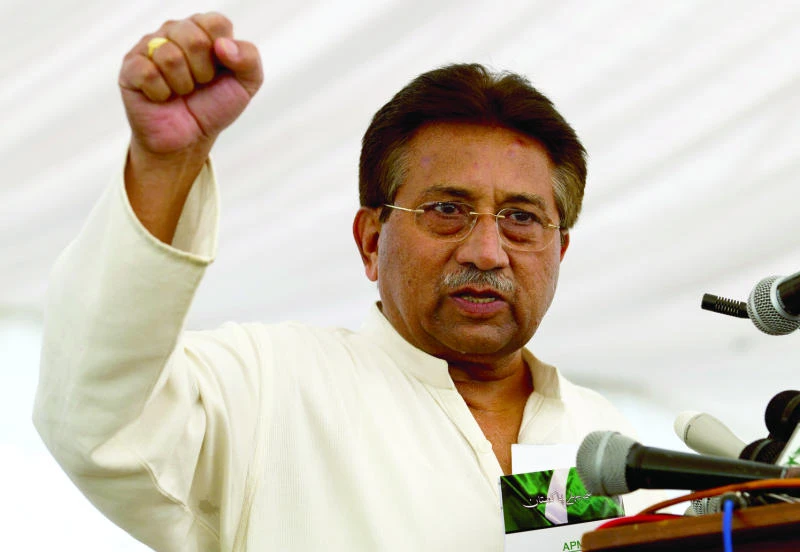
PESHAWAR: A Pakistani court moved yesterday to ban former military ruler Pervez Musharraf from contesting elections for the rest of his life, a step which his aides immediately vowed to challenge.
The retired general has been humiliated since returning last month from self-imposed exile to contest elections and is currently under house arrest.
He will spend the May 11 general elections under lock and key, after an anti-terrorism court in the garrison city of Rawalpindi put him under house arrest for 14 days over the death of politician Benazir Bhutto in 2007.
Just hours later, a court in the northwestern city of Peshawar dismissed an appeal against his disqualification from standing for election in the district of Chitral and banned him for life from running for parliament, lawyers said.
The ban extended to the lower and upper houses of the federal parliament and to all provincial assemblies, lawyer Mohibullah Tarichvi said.
A spokesman for Musharraf’s All Pakistan Muslim League party, Muhammad Amjad, was circumspect.
“We can challenge it,” he said.
A court in the eastern city of Lahore is scheduled to rule May 7 on separate appeals against his disqualification for the current election in other seats. He applied to stand in a total of four constituencies.
“If the court upholds the disqualification then we will go to the Supreme Court,” Amjad said.
Musharraf had promised to “save” the country from militancy and economic collapse but was barred from running as a candidate over charges dating back to his 1999-2008 rule.
He will now spend polling day in his Islamabad villa, which has been designated as a jail, making his chances of even voting remote.
Musharraf’s lawyer Ibrahim Satti said that his client could request a postal vote but said a government-facilitated visit to a polling station would be unlikely “because of security concerns.”
The retired general is also under house arrest for sacking judges when he imposed emergency rule in 2007.
Musharraf is accused of conspiracy to murder former prime minister Bhutto, whose Pakistan People’s Party was elected into power in 2008 on a wave of sympathy over her death in a gun and suicide attack.
Besides the sacking of judges, he faces a third legal case over the 2006 death of a Baluch rebel leader and has been threatened with death by the Taleban.
Nobody has ever been convicted or jailed for Bhutto’s assassination. Musharraf’s government blamed the killing on Pakistani Taleban chief Baitullah Mehsud, who denied any involvement and was killed in a US drone attack in 2009.
But Bhutto’s son, Bilawal Bhutto Zardari, who is PPP chairman, has accused Musharraf of her murder.
In 2010 a UN report said Bhutto’s death could have been prevented and accused Musharraf’s government of failing to give her adequate protection.
Candidate shot dead
A Pakistani candidate for elections next week was shot dead yesterday in an exchange of fire with security forces at a checkpoint in restive southwestern Baluchistan province, officials said.
Violence has spiked in the nuclear-armed country ahead of national elections on May 11 with at least 61 people killed in attacks on politicians and political parties since April 11.
Abdul Fateh Magsi, running for the regional assembly in Baluchistan as an independent, was killed when his guards exchanged fire with tribal policemen at a checkpost outside the town of Jhal Magsi, south of the provincial capital Quetta.
“The security forces signaled to Abdul Fateh Magsi and his guards to stop at a check post, but they did not. At this, they exchanged fire and Magsi and his two guards were killed,” Baluchistan home secretary Akbar Hussain Durrani said.
“Two other guards with Magsi were injured while security forces discovered two rocket launchers in their vehicles and arrested five other members of the convoy,” said Durrani.
District administration chief Saeed Ahmed Imrani said the incident took place before dawn on Tuesday.
Baluchistan is one of the most deprived areas of Pakistan. It suffers from a separatist insurgency waged by Baluch rebels, militancy and sectarian violence against the Shiite Muslim minority.
In much of the country, fear of attack and a direct threat from the Taleban against the three parties in the outgoing government have curtailed public rallies ahead of the May 11 polls.
Amnesty International has called on Pakistan to investigate the recent wave of attacks and ensure adequate protection for election candidates.
The polls should see power pass from a civilian government that has served a full term to another through the ballot box for the first time in the nuclear-armed country’s turbulent history.