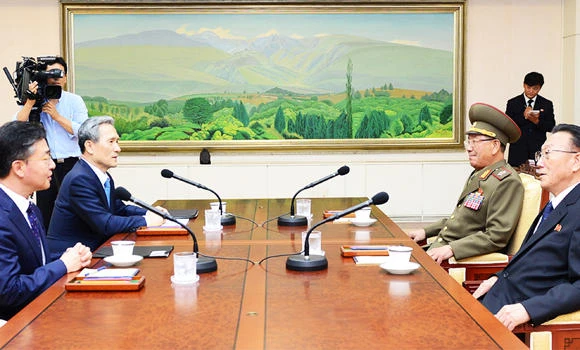
SEOUL: Top aides to the leaders of North and South Korea held talks at the Panmunjom truce village straddling their border late on Saturday, raising hopes for an end to a standoff that put the rivals on the brink of armed conflict.
The meeting at the Demilitarised Zone (DMZ) village, known for its sky-blue huts and grim-faced soldiers, began soon after the deadline for North Korea’s previously set ultimatum demanding that the South halt its loudspeaker propaganda broadcasts along the border or face military action.
That deadline passed without any reported incidents.
The negotiations continued after roughly three hours, according to the South’s Unification Ministry.
An exchange of artillery fire on Thursday prompted calls for calm from the United Nations, the United States and the North’s lone major ally, China. South Korea’s military remained on high alert despite the announced talks, a defense official said.
South Korean President Park Geun-hye’s national security adviser and her unification minister met with Hwang Pyong So, the top military aide to the North’s leader Kim Jong Un, and Kim Yang Gon, a veteran official in inter-Korean affairs.
“The South and the North agreed to hold contact related to the ongoing situation in South-North relations,” Kim Kyou-hyun, the presidential Blue House’s deputy national security adviser, said earlier in a televised briefing.
Pyongyang made an initial proposal on Friday for a meeting, and Seoul made a revised proposal on Saturday seeking Hwang’s attendance, Kim said.
The North’s KCNA news agency also announced the meeting, referring to the South as the Republic of Korea, a rare formal recognition of its rival state, in sharp contrast to the bellicose rhetoric in recent days.
“They need to come up with some sort of an agreement where both sides have saved face. That would be the trick,” said James Kim, a research fellow at the Asan Institute for Policy Studies in Seoul.
“North Korea will probably demand that the broadcasts be cut, and they may even come to an impasse on that issue.”
North Korea, technically still at war with the South after their 1950-53 conflict ended in a truce, not a peace treaty, declared a “quasi-state of war” in front-line areas and on Thursday set the deadline for Seoul to halt its broadcasts.
South Korea began blasting anti-North propaganda, news reports and even entertainment over the DMZ on Aug. 10, days after land mine explosions in the DMZ wounded two South Korean soldiers. Pyongyang denies it planted the mines.
Seoul said it would continue the broadcasts unless the North accepted responsibility for the blasts.
“The situation on the Korean peninsula is now inching close to the brink of a war due to the reckless provocations made by the south Korean military war hawks,” the North’s KCNA news agency said earlier.
South Korean Vice Defense Minister Baek Seung-joo said on Friday Seoul expected North Korea to fire at some of the 11 sites where it has set up loudspeakers.
The United States, which has 28,500 soldiers based in South Korea, said on Friday it had resumed its annual joint military exercises there after a temporary halt to coordinate with Seoul over the shelling from North Korea.
The drills, code-named Ulchi Freedom Guardian, began on Monday and run until next Friday. North Korea regularly condemns the maneuvers as a preparation for war.
Four South Korean and four US fighter jets flew in a joint sortie over the South on Saturday, a South Korean official said, as thousands of South Korean villagers living near the border were evacuated into shelters.
Rival Koreas hold high-level talks in bid to ease tension