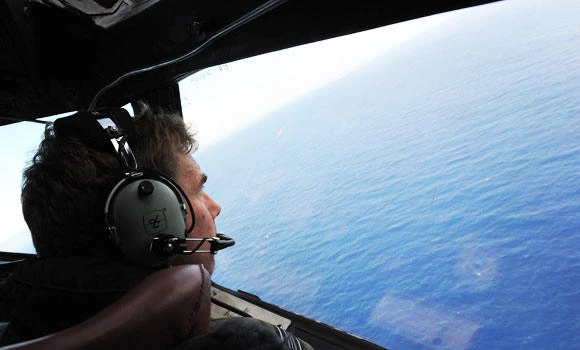
SYDNEY: A deep-sea hunt for the missing Malaysian passenger jet has focused on the wrong place for nearly two months, officials said Thursday, after a survey of a remote stretch of the Indian Ocean found no trace of wreckage.
A zone where acoustic pings like those emitted by aircraft black boxes were detected in early April “can now be discounted as the final resting place of MH370,” Australia’s Joint Agency Coordination Center said in a statement. The undersea survey using robot submarines will resume over a wider 60,000 square kilometer (23,000 square mile) area in August.
The announcement is the latest setback in what is already the longest search mission of the passenger-jet era. Investigators have scoured waters from the South China Sea to the Southern Ocean without finding a fragment of the Boeing 777-200, which disappeared on March 8 with 239 people on board.
“It’s a pretty straightforward case of trying to find a needle in a very big haystack,” Peter Marosszeky, a lecturer in aviation at the University of New South Wales in Sydney, said by phone Thursday. “To locate anything on the sea floor is always very difficult.”
Investigators have scoured a 850-square-kilometer stretch of the ocean floor since April 14 using side-scan sonar, after an underwater microphone picked up four signals like those emitted by aircraft black boxes on April 5 and April 8.
The sonar technology was used to locate the lost Air France 447 aircraft off the coast of Brazil, and can pick out objects less than a meter in size.
“The audible signal sounds to me just like an emergency locator beacon,” the agency’s chief Angus Houston told a media conference April 7 announcing the detection of the first two pings. “We’re very close to where we need to be.”
That survey was called off without success Wednesday, and investigators will now use ship-based sonar to assemble a more accurate map of the seabed before resuming the hunt, the Agency said. The renewed undersea search will be carried out by private contractors and won’t start until the seabed mapping is complete in about three months.
“The search in the vicinity of the acoustic detections can now be considered complete,” the agency said on Thursday.
Search for MH370 was in wrong place, says Australia