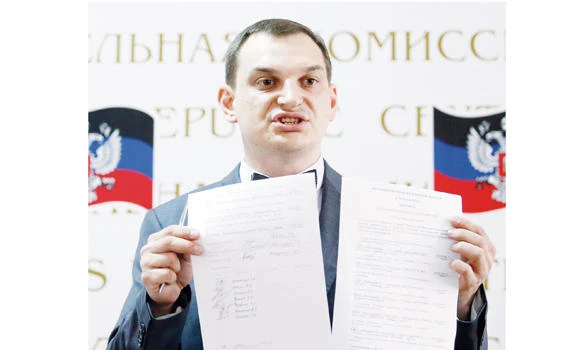
DONETSK, Ukraine: Ukraine’s central government and the West on Monday strongly criticized Sunday’s hastily arranged, unofficial ballot in the Donetsk and Luhansk regions — which together have 6.5 million people — as a sham and a violation of international law. They accuse Moscow of fomenting weeks of unrest in eastern Ukraine in a possible attempt to grab more land after annexing Crimea in March — accusations that Russia denied.
“The farce, which terrorists call the referendum, will have no legal consequences except the criminal responsibility for its organizers,” Ukraine’s acting President Oleksandr Turchynov said in a statement.
In Moscow, Russian President Vladimir Putin’s office urged the Ukrainian government to engage in talks with representatives of eastern Ukraine that could be brokered by the Organization for Security and Cooperation in Europe.
The cautious stance — which contrasted with Russia’s quick annexation of Crimea after a separatist vote there — appears to reflect Putin’s hope of negotiating a solution to what has become the worst crisis between Russia and the West since the Cold War.
“The practical implementation of the referendum results should proceed in a civilized way without any throwbacks to violence through a dialogue between representatives of Kiev, Donetsk and Luhansk,” the statement said.
The Kremlin said on Monday that Moscow has no intention of immediately annexing two regions in eastern Ukraine.
The pro-Russia insurgents who organized Sunday’s vote claimed 89 percent of those who cast ballots in the Donetsk region and about 96 percent of those who turned out in the neighboring Luhansk region voted for sovereignty. It remained unclear whether the vote could lead to their secession, but Vasily Nikitin, a spokesman for the insurgents in Luhansk said the region will not vote in Ukraine’s May 25 presidential election.
Meanwhile, European Union foreign ministers added 13 people to their visa ban and asset freeze list over Ukraine’s crisis but are not expected to decide whether to impose tough economic measures on Russia before Ukraine’s elections, officials said.
The 28 EU ministers also said that two firms in Crimea would be hit with asset freezes. The ministers agreed to expand the scope of visa bans and asset freezes to target people undermining stability in Ukraine or obstructing international organizations there. The Obama administration has its own sanctions list that targets several close associates of Russian President Vladimir Putin and their assets for Russia’s actions in Ukraine.
France’s European affairs minister, Harlem Desir, said additional EU sanctions may be imposed if “actions and provocations” hamper the Ukraine presidential election campaign. He said the 13 people targeted Monday included “Ukrainian separatists and Russian officials.”
A total of 61 people are now on the EU’s sanctions list due to Ukraine.
Beyond the visa and asset measures, British Foreign Secretary William Hague said it is essential to show Moscow the bloc is ready to step up measures further “depending on Russia’s attitude toward the elections” in Ukraine.
France and Germany had already called on Russia to promote de-escalation in Ukraine so its presidential elections could take place May 25. If there is no action from President Vladimir Putin, the EU could increase sanctions, the two nations said.
The EU threw its weight behind efforts of the Organization for Security and Cooperation in Europe set up talks in Ukraine to contain the chaos and violence. France and Germany have already called for a “national dialogue” between the interim government in Kiev and representatives of all Ukrainian regions.
Ukraine denounces referendum as ‘farce’