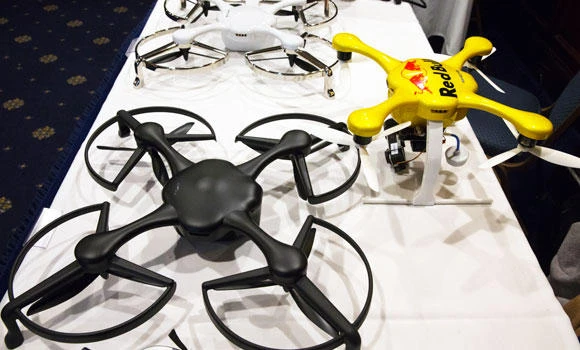
WASHINGTON: Letting small drones fly for profit in US airspace would give a big lift to the development of unmanned aerial vehicles of all sizes, a Congressional committee heard.
The Federal Aviation Administration (FAA) has yet to propose a full set of regulations for civilian drones — a delay that critics fear is undermining US competitiveness in drone technology.
Appearing before the House of Representatives science committee, James Williams, head of the FAA’s unmanned aerial vehicles (UAV) integration office, said he was unable to give a deadline for such rules to emerge.
“Our goal is to get it out as quickly as possible, as long as we get it right,” said Williams, adding that the FAA is collaborating with partners in the Obama administration on the issue.
But Colin Guinn of the Small UAV Coalition, an industry group, argued in favor of allowing light-weight, low-altitude drones — weighing no more than five pounds (two kilograms) — to fly commercially now.
“There are many commercial uses for the smallest UAVs,” said Guinn, an executive at California drone maker 3D Robotics, who previously helped develop the wildly popular DJI Phantom quadcopter.
“Experience gained from these operations... will provide lots of data to inform the development of other small UAVs, up to 55 pounds, as well as larger UAVs,” he said.
That data could help fine-tune such innovations as “geo-fencing,” in which GPS signals are used to precisely limit a drone’s area of flight.
US Congress under pressure to let small drones fly