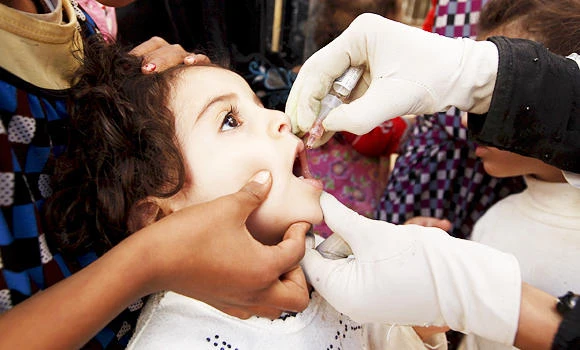
LONDON: In a huge immunization effort in 150 countries, health teams will on Sunday launch what they hope will be the final push against polio.
Stopping transmission of the contagious viral disease that has infected millions is possible within a year, experts say. And full, official, global eradication could be declared by the end of this decade.
First, however, the vaccine that has successfully fought polio for more than 30 years needs to be switched for one that targets the last few areas of risk.
It won’t be easy, or cheap, but the World Health Organization’s director of polio eradication, Michel Zaffran, says failure now — when there have only been 12 cases worldwide this year, in Pakistan and Afghanistan — means the virus could spread across borders again.
Success would make polio only the second human disease to be eradicated since smallpox was banished in 1980.
“Taking our foot off the pedal now could mean polio will within a few years spread straight back into large parts of the world and create 100,000 or 200,000 cases,” Zaffran told Reuters. “The job has not been done and will not be done until we have fully eradicated the virus.”
For the endgame in polio to succeed, a coordinated and complex vaccine switch is crucial.
Until now, many countries have been using a shot that protects against the three types of wild polio virus — type 1, type 2 and type 3 — but type 2 polio transmission has been stopped since 1999, meaning immunizing against it now makes no sense.
In rare cases it also poses a risk that the weakened type 2 virus in the vaccine can seep into circulation and cause “vaccine-derived” polio infections.
So from April 17 to May 1, some 150 countries will engage in a synchronized switch to a bivalent, or two-strain, vaccine that contains no type 2 virus but targets types 1 and 3.
It’s a massive undertaking and a major step toward eradication, says Zaffran. “We’re entering into uncharted territory. This has never been done before. But there’s no going back now.”
That’s partly because polio vaccine manufacturers — among them France’s Sanofi Pasteur — have moved production to the bivalent shot and would find it tricky, costly, and time-consuming to reverse that move.
Anil Dutta, a vaccine expert at British drugmaker GlaxoSmithKline, which also makes polio shots, is looking beyond eradication to 2019 or 2020, when all “live” oral polio vaccines need to be discontinued.
Then the world will switch again, to “inactivated” polio vaccine, or IPV, to further reduce any risk of causing disease through immunization. Scaling up IPV production to meet the needs of the entire world takes years, he warns, and work must start now to avoid potential supply concerns.
Vaccine switch a crucial step in polio endgame