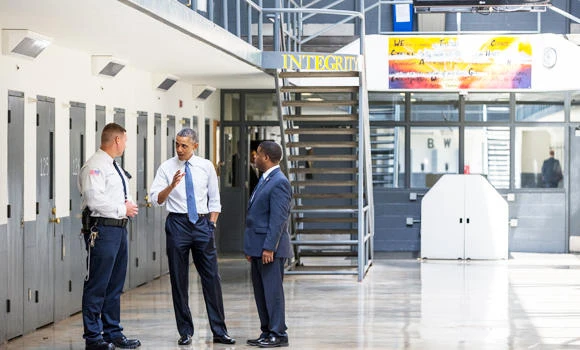
WASHINGTON — The Justice Department is set to release about 6,000 inmates early from prison — the largest one-time release of federal prisoners — in an effort to reduce overcrowding and provide relief to drug offenders who received harsh sentences over the past three decades, according to US officials.
The inmates from federal prisons nationwide will be set free by the department’s Bureau of Prisons between Oct. 30 and Nov. 2. About two-thirds of them will go to halfway houses and home confinement before being put on supervised release. About one-third are foreign citizens who will be quickly deported, officials said.
The early releases follow action by the US Sentencing Commission — an independent agency that sets sentencing policies for federal crimes — that reduced the potential punishment for future drug offenders last year and then made that change retroactive.
The commission’s action is separate from an effort by President Obama to grant clemency to certain nonviolent drug offenders, an initiative that has resulted in the early release of 89 inmates.
The panel estimated that its change in sentencing guidelines eventually could result in 46,000 of the nation’s approximately 100,000 drug offenders in federal prison qualifying for early release. The 6,000 figure, which has not been reported previously, is the first tranche in that process.
“The number of people who will be affected is quite exceptional,” said Mary Price, general counsel for Families Against Mandatory Minimums, an advocacy group that supports sentencing reform.
The Sentencing Commission estimated that an additional 8,550 inmates would be eligible for release between this Nov. 1 and Nov. 1, 2016.
The releases are part of a shift in the nation’s approach to criminal justice and drug sentencing that has been driven by a bipartisan consensus that mass incarceration has failed and should be reversed.
Along with the commission’s action, the Justice Department has instructed its prosecutors not to charge low-level, nonviolent drug offenders who have no connection to gangs or large-scale drug organizations with offenses that carry severe mandatory sentences.
The US Sentencing Commission voted unanimously for the reduction last year after holding two public hearings in which members heard testimony from then-Attorney General Eric H. Holder Jr., federal judges, federal public defenders, state and local law enforcement officials, and sentencing advocates. The panel also received more than 80,000 public comment letters, with the overwhelming majority favoring the change.
Washington to free about 6,000 inmates