
UNITED NATIONS, 8 March 2003 — The United States, Britain and Spain yesterday delivered a March 17 ultimatum to Iraq to cooperate fully with disarmament demands or face war, but three major nations with UN veto power remained opposed to military action.
In a forceful speech, British Foreign Secretary Jack Straw announced the new resolution at a tense Security Council meeting.
Diplomats said US and Britain want the Council to vote on the new resolution on Tuesday.
The text of the revised resolution said: “Iraq will have failed to take the final opportunity afforded by Resolution 1441 unless on or before March 17, 2003, the Council concludes that Iraq has demonstrated full, unconditional, immediate and active cooperation with its disarmament obligations.”
Resolution 1441, passed last November, set up inspections of Iraqi weapons sites and demanded that Iraq end all nuclear, chemical, biological and ballistic missile programs and supply proof it had done so.
The new ultimatum said Iraq must hand over to UN inspectors all weapons, delivery systems and support systems and structures banned by the United Nations and also provide information about the prior destruction of such items by March 17.
That date now becomes zero hour before the United States and its allies unleash the more than 300,000 troops committed to the Gulf region.
Prospects that the new resolution would pass the Security Council seemed slim. It would need the votes of nine of the 15 members and no vetoes to succeed. France, China and Russia said they were opposed to war and any of the three could kill the resolution by using their veto power.
Speaking before the new resolution was tabled, French Foreign Minister Dominique de Villepin said: “We cannot accept an ultimatum as long as the inspectors are reporting progress. That would mean war.”
“France will not allow a resolution to pass that authorizes the automatic use of military force,” he said.
Russia and China also said they opposed war. “There is no reason to shut the door to peace,” said Chinese Foreign Minister Tang Jiaxuan.
US President George W. Bush said Thursday he was ready to launch war with or without United Nations approval. He said he would push the Security Council for a vote within days but would fulfill what he saw as his duty to protect the American people regardless of the outcome.
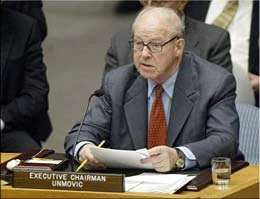
The day at the United Nations began with a mixed report from UN chief weapons inspector Hans Blix that left the major powers more divided than ever on the looming war.
Blix’s latest report gave some backing to both sides. He told the Security Council that Iraq’s move to begin destroying its Al-Samoud 2 missiles constituted “a substantial measure of disarmament” but criticized the rate at which the Iraqis had handed over documents on prohibited chemical and biological systems.
Mohamed El-Baradei, the head of the UN nuclear watchdog agency, also gave his report to the Security Council, saying there was no evidence Iraq had resumed its nuclear program.
He said the documents backing US and British allegations that Iraq had attempted to import uranium from Niger were “not authentic.”
If war did come, Bush said the US-led coalition would remove the government of Iraqi President Saddam Hussein.
However, going to war without UN approval would be certain to stoke an already powerful anti-war movement around the world, intensify anti-American sentiment and could shake the political support of important allies, including British Prime Minister Tony Blair.
German Foreign Minister Joschka Fischer said he found it “incomprehensible” that the world community could abandon peaceful efforts to disarm Iraq and opt for a war that would bring death and destruction to thousands of “innocent people.”
But US Secretary of State Colin Powell dismissed Blix’s talk of increased Iraqi cooperation, saying he still found “a catalogue of noncompliance” by Baghdad.

