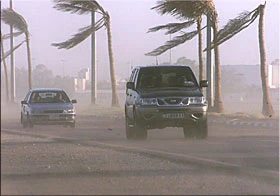
DAMMAM/KUWAIT, 14 March 2003 — Sand whipped up by searing winds blanketed much of the Gulf yesterday, reducing visibility and forcing the mercury up to record levels.
While a wild Kuwaiti sandstorm pinned down more than 160,000 US and British troops close to the border with Iraq, heavy dust was reported in Dhahran and Bahrain where visibility was as low as 100 meters.
Drivers used headlights as visibility dropped and sand blew across highways, slowing traffic.
Much of the Gulf has been under a blanket of suffocating dust since Wednesday. “It’s extreme and extremely hot, close to the records,” Dubai weather forecaster Clive Stevens was quoted as saying by AFP.
A trough of low pressure extending from southern central Iran down across Qatar and low pressure to the west of the Empty Quarter sent winds gusting over 30 knots (34.5 miles per hour) through the region.
Abu Dhabi sizzled on Wednesday in 42 degrees C (108 F). Relative humidity dropped as low as eight percent.
US and British troops stationed on the Kuwait-Iraq border were clearing the dust from their gun barrels and sweeping out tents yesterday after being caught in the storm.
Sandstorms are not abnormal in the arid desert region, raising fears that any invasion of Iraq could be hampered by the extreme weather.
“The severe dust storm could have been made worse by intense military activity disrupting the sands of the northern desert,” a meteorologist at Kuwait airport was quoted as saying by a news agency.
Visibility was reduced to 50 meters in open areas, the meteorologist said, but by midday yesterday the worst appeared to be over.
The temperature in Kuwait rose to 30 degrees C on Wednesday, five degrees above the average maximum for the time of year, but dropped back to 26 degrees C later.
Sandstorms hit the emirate too last week, causing heavy swells in the ports and delays in unloading military hardware from ships.
“But the Marines will continue to drive on with the equipment that they have,” Lt. Joshua Lyons said. “We’ve got goggles and scarves and while visibility can have an effect, we still have to perform. It might take longer but we’ll still get the job done.”
Kuwait’s northern desert is now home to some 160,000 US and British troops and a vast array of military hardware, ready for a possible invasion of Iraq. And the longer the troops wait to go to war, the warmer the weather will get, in summer reaching levels that melt roads.
Last July, the thermometer rose over 50 degrees C in the shade, usual for a largely desert country without rivers.
US generals are planning a quick war.
The record shade temperature in Kuwait City is 51.3 degrees C, and southern Iraq suffers similar scorchings every year.
The meteorological office in Dubai said 41 degrees C was the March high since records began in the United Arab Emirates in 1974.
The outlook for the next 24 hours was for the wind to ease and veer offshore, leaving the dust to clear away and temperatures to drop to a more seasonal 28 degrees C. Isolated thunderstorms were also predicted in the southern Gulf.