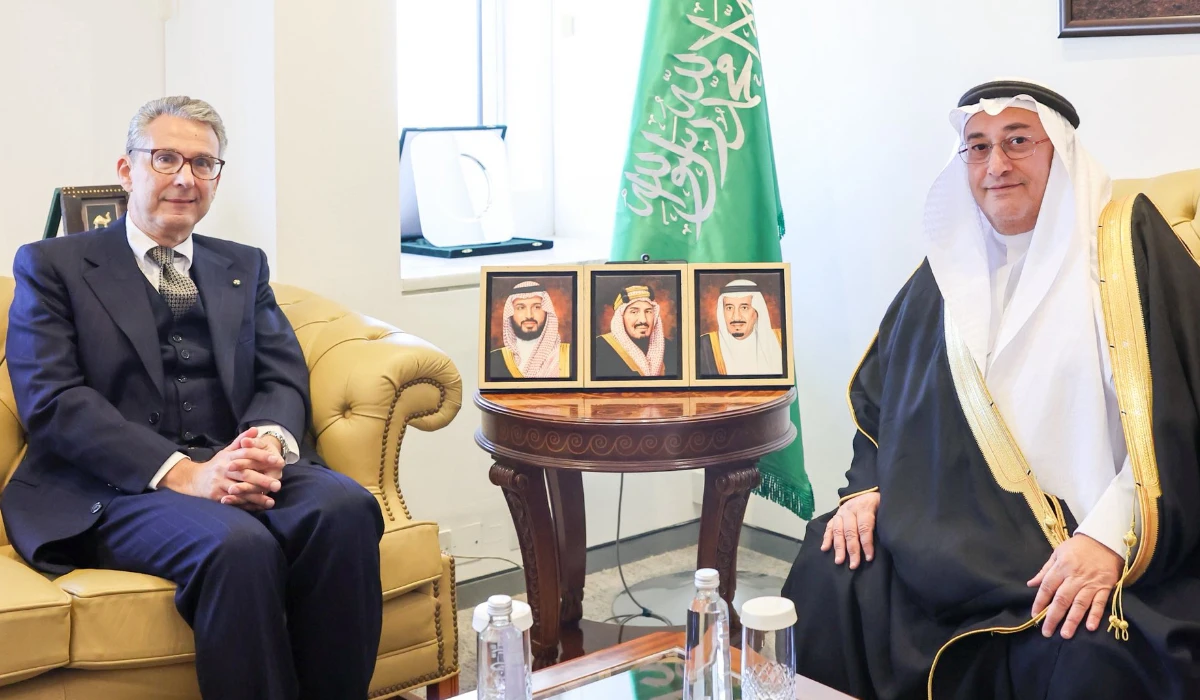
RIYADH, 14 April 2003 — The Kingdom and France agreed yesterday that return of Iraq to Iraqi control must remain a priority.
After meeting with his French counterpart, Dominique de Villepin, on a whistle-stop tour of Arab capitals, Foreign Minister Prince Saud Al-Faisal announced: “We agree on two main points: Re-establishing the control of Iraq by the Iraqi people and their security and stability by taking steps ... as quickly as possible.”
The second point was to ensure “humanitarian aid for the Iraqi people in these extremely difficult circumstances,” the prince added.
Both the Kingdom and France opposed the US-led war in Iraq. Saudi Arabia last week called for the Iraqi people to be allowed to choose their own government and decide their own future.
Saudi Arabia was the last leg of de Villepin’s tour of Arab countries, which has taken him to Egypt, Syria and Lebanon. Shortly before flying back to Paris, the French foreign minister said it was essential that all parties concerned by the problems of Iraq and the Middle East showed “moderation and restraint”.
As to the continuing problems between Palestine and Israel, Prince Saud said: “We have a united assessment of the problem. We believe that the occasion is right to try to resolve the problem.”
He also expressed hope that the so-called Quartet of the European Union, United Nations, Russia and the United States, who have drawn up the “road map” for peace, would “act as quickly as possible.”
During his visits to Cairo, Damascus and Beirut, de Villepin called for the return of United Nations weapons inspectors to Iraq and for sanctions against Baghdad to be lifted as soon as possible. He also urged the US-led coalition in Iraq to restore law and order, and for the United Nations to play a central role in the Iraqi issue.
In Damascus, de Villepin called for an end to the war of words between the United States and Syria over the latter’s alleged support for the ousted regime of Saddam Hussein. De Villepin enjoys wide popularity in the Arab world for France’s strong anti-war stance in the UN Security Council during the seven-month diplomatic tussle that preceded the US-led invasion of Iraq on March 20.
In Riyadh, he was to have met Crown Prince Abdullah, deputy premier and commander of the National Guard, but the crown prince was forced to cancel the meeting in order to attend the funeral of former Makkah Governor Prince Majed, who died on Saturday.
AFP adds: British Foreign Secretary Jack Straw and his deputy headed yesterday for no less than six Middle East and Gulf states as the diplomatic race to shape the region’s future post-Saddam Hussein heats up.
Straw was traveling to Saudi Arabia, Bahrain, Kuwait and Qatar, less than a week after Baghdad fell to US Marines with barely a fight.
Separately, Straw’s Minister for Middle East Affairs, Mike O’Brien, was going yesterday to Iran and Syria, key players in how the Middle East will emerge in the wake of the collapse of Saddam’s regime.
In London, circumspect Foreign Office official said only that Straw and O’Brien would be discussing “a range of bilateral issues” during their respective missions, “including Iraq.”