BEIRUT, 17 February 2005 — Hundreds of thousands of frenzied mourners swarmed the streets of Beirut in a sea of Lebanese flags yesterday as they bade farewell to former Prime Minister Rafik Hariri amid rising public outcry against Syria, blamed by opposition leaders for the suspected suicide car bombing that killed him on the city’s beachfront on Monday.
Men wept uncontrollably as the funeral procession, attended by at least 150,000 Lebanese, wound through Beirut streets plastered with Hariri’s posters.
“Syria out, Syria out,” the mourners shouted as people threw rice from balconies onto an ambulance carrying the body of a man who had joined calls for Syrian troops to leave Lebanon.
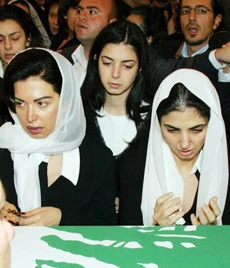
In tears, Hariri’s sons and relatives bore his flag-draped coffin from the ambulance into an unfinished mosque Hariri had financed in Beirut’s once war-shattered downtown. Some mourners fainted amid chaotic scenes as the crowd surged around the coffin before Hariri was laid to rest in the grounds of the mosque a few hundred meters from the seafront.
Hariri’s family spurned government offers of a state funeral and made clear top Syrian-backed officials were not welcome. Parliament Speaker Nabih Berri was however present.
Prince Saud Al-Faisal, who headed the Saudi delegation to the funeral, called for a speedy investigation and quick capture of Harisi’s assassins to avoid “unpleasant consequences.”
The top US envoy to the Middle East, William Burns, called in Beirut for the “complete and immediate” withdrawal of Syrian troops from Lebanon and demanded a “credible” investigation into the assassination.
The United States, while stopping short of directly holding Syria responsible, has recalled its ambassador and warned of deteriorating ties, although Damascus insists it had no role in the murder.
The assassination of Hariri, who served as premier five times since the end of the 1975-1990 war but resigned in October over Syria’s domination of this country, has stoked fears of a return to the dark days of civil conflict.
“Beirut weeps for its martyr. Beirut salutes Rafik Hariri,” said one banner at the funeral which passed without serious incident despite the outpouring of emotion on the streets.
The nation, still bearing the scars of the war despite its political and economic reconstruction, was united in grief as mourners from all communities joined the funeral.
No other Lebanese politician has ever had such an emotional send-off from the patchwork of religions which make up Lebanon, observers said. Church bells rang out as the procession slowly wound its way through the streets of Beirut.
Lebanon’s army went on high alert after the killing of Hariri, an attack which Interior Minister Suleiman Franjieh said was probably the work of a suicide bomber.
However he rejected as “unacceptable” calls for an international probe as suggested by Lebanon’s former colonial power France. But feeling the pressure, the military judiciary said yesterday Swiss explosives and DNA experts would be brought in to facilitate the investigation.
French President Jacques Chirac, a close friend of the slain premier, flew in to pay condolences to the Hariri family and said the international community demanded that “light be shed in this indescribable and abominable act”.
Hariri was killed on Monday with 14 other people, including seven of his bodyguards, when a huge explosion ripped through his motorcade on the Beirut seafront, leaving a trail of destruction not seen in the capital since the 1975-90 civil war.
Hariri, a business tycoon who also held Saudi nationality, resigned as prime minister four months ago in a row over Syrian dominance of Lebanon and the continued presence of about 15,000 troops on its soil.
But anger at Hariri’s death turned violent elsewhere yesterday when a group of people hurled stones at Syrian workers and beat them up in Hariri’s southern hometown of Sidon, in the second such incident in as many days.
Regional commentators watched with trepidation as Hariri’s killing raised domestic and international tensions ahead of planned elections in May.
“The repercussions of the assassination could be dangerous if the Lebanese street does not stay united,” Arab League spokesman Hossam Zaki warned in Cairo.
“We must take great care that the Middle East does not get caught in a new dragnet of violence or that another tinderbox explodes to douse the flames of Palestine and Iraq.”
Syria, which has condemned Hariri’s assassination and denied responsibility, reacted calmly to the US recall of its envoy, called for dialogue, not confrontation.
Imad Moustapha told CNN he saw no immediate US threat to Syria, but said he was “appalled” by the political atmosphere and blame being placed on Syria for Hariri’s death.
“We think that the atrocious crime that took place in Beirut two days ago ... should not be used for political reasons to score points against Syria,” Moustapha said.
People in the streets of Damascus voiced particular shock at the strident criticism of Syria’s role from the Lebanese.
“If they feel this way, then I say we should withdraw and let them break each other like falling water melons,” said a Syrian student who gave his name as Amjad.
— With input from agencies