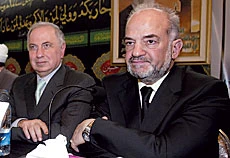
BAGHDAD, 23 February 2005 — The Iraqi alliance that won the Jan. 30 elections yesterday chose Ibrahim Jaafari for prime minister after his rival Ahmad Chalabi withdrew as a candidate.
Jaafari, the head of the Islamist Dawa Party, had faced competition from inside the alliance from Chalabi, once favored by the Pentagon. But Chalabi withdrew as a candidate at a meeting in Baghdad, and the United Iraqi Alliance unanimously approved Jaafari.
“The priority now is security... it affects all other issues, such as the economy and rebuilding,” Jaafari told a news conference to announce his nomination.
He said if he became prime minister he would work to improve the capability of security forces and increase their numbers.
Jaafari still faces a challenge from incumbent interim Prime Minister Iyad Allawi. But Allawi’s list won only 14 percent of the vote in the election, while the UIA won 48 percent — enough for a majority in the National Assembly — and has insisted on having the top job.
Jaafari spent more than two decades in exile, mostly in Iran, leading anti-Saddam Hussein opposition forces following a bloody crackdown by the Iraqi dictator against Shiites. He fled to Iran in 1979 and remained there until 1990, organizing cross-border attacks. He was seen as the leader of a pro-Tehran faction of the Dawa with close ties to the country’s clerical government — though he denies any such links.
In 1990, Jaafari left Iran for England when the Dawa split into two camps — one which backed closer ties with Iran and the other opposing Iranian influence. He returned to Iraq after the US-led invasion in 2003 that toppled Saddam’s regime and became a key member of the UIA, a political coalition that included the Dawa and the Supreme Council for the Islamic Revolution in Iraq, the country’s other main Shiite faction.
Jaafari was born in Karbala and was educated at Mosul University as a medical doctor. A wily politician known for playing his cards close to his chest, he told The Associated Press in a recent interview that suspicion over his links with Iran was a “widespread, mistaken belief.” “An Iraqi remains an Iraqi all his life, wherever he goes,” he said.
The present interim government, along with lawmakers chosen in the Jan. 30 elections, will decide when the new assembly will meet. No date has been set, however, and the timing is likely to be dependent on back-room dealing and horse-trading among the various parties, who are expected to first agree unofficially among themselves the makeup of the new government.
Once the assembly meets, its first order of business will be to elect, by a two-thirds majority vote, a so-called Presidency Council, composed of a largely ceremonial president and two vice presidents.
Once the Presidency Council is established, it has two weeks to unanimously choose an official candidate for prime minister, who must then be approved by the assembly with a simple majority vote of confidence. If the three council members fail to agree unanimously on a nominee for prime minister, the assembly must do so by a two-thirds majority vote.
The prime minister has one month to nominate his Cabinet and present his choices to Parliament. If he fails to do so, the Presidency Council must name another prime minister. The prime minister and his Cabinet must be confirmed by the assembly with a simple majority vote of confidence before starting their work as a government.
The assembly’s most important task will be to create a committee to draft a permanent constitution. Iraqis will vote on the proposed constitution in a referendum by Oct. 15.
If the constitution is approved, elections for a permanent government to replace the assembly will be held in December. If voters reject the charter, the National Assembly will be dissolved and a new transitional assembly elected in December to take another stab at constitution-writing.