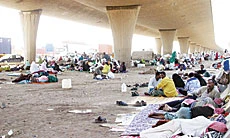
JEDDAH, 27 February 2005 — Hundreds of African pilgrims are camped under the bridge near the Jeddah Islamic Port waiting for their turn to be deported.
The pilgrims are left there without food, shelter, money or health care. They do not have the slightest clue as to when they will be deported to their home countries.
If hunger or sickness doesn’t get them, the cars speeding by will.
Arab News met with the pilgrims who spoke in their native Nigerian dialect were frustrated and angry. Our camera attracted a group of them. One Nigerian, who spoke English and Arabic, offered to translate.
“We have been here for a month, under the same bridge, waiting to go home,” said 50-year-old Mahmood Khalilo.
When asked who brought him to the bridge, Khalilo replied that the Passports Department personnel dropped him there and took away his passport. “They show up weekly and pick up 300 to 500 pilgrims and take them to the airport to be deported.”
According to the Nigerian translator, two days ago, the Passports Department officials came and only took 150 people. “This scared a number of us, but we know there are others who share our experience in different sites of the city,” said the translator who added that the Passports Department personnel show up weekly and call out names and hand back their passports, and ask them to head to the airport.
Why don’t they have tickets? “A majority of us have been here for more than three months, some since Ramadan. Our tickets have expired, and so we headed to the Passports Department to get deported. We have no water, no food, no money; some of us need medical treatment,” said Haji Abdullah, a 52-year-old Nigerian pilgrim.
The majority of pilgrims under the bridge were Nigerians; a minority were Sudanese and Somalis, the translator pointed out.
Haji Abdullah said: “Come see, take pictures of our sick people who need medical attention; a number of our men have either died or injured while crossing the street.”
Arab News followed Abdullah across the street, passing hundreds of Africans lying on the side of the streets. Some pilgrims have built small shelters out of wood and cardboard boxes to keep them away from the harsh sun. We entered a stinking building. Very few were sleeping inside the building; most of them stayed in the yard where they could breathe fresh air. Many simply sat on any available piece of ground. The most unfortunate were the sick ones.
“We only want one thing and that’s to go back to our country,” said Muhammad Tanim Abu Bakr, a 25-year-old Nigerian from Kano. “How can we reach our embassy? We need our problems and complaints to be sorted out,” he said.