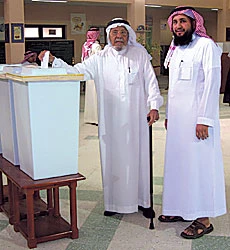
ALKHOBAR, 4 March 2005 — I could not vote in yesterday’s elections but even I, a Saudi woman, could not be stopped from bearing witness to the seriousness and enthusiasm of the men who turned out to elect the members of the municipal council in the Eastern Province. Their eagerness to participate in this historic event was completely unexpected and a splendid surprise. It was extremely touching to see men of 70 and 80 years of age, no longer able to walk unaided, insisting to make their way to the ballot box and drop in their ballots by their own hands.
The kindness and perseverance of the election officials is to be commended. Again and again they showed voters how to fill out the ballots, instructed them to fold the ballot before dropping it in the ballot box and congratulated each voter for finding the time to participate in the election. If only all our officials could behave in such a courteous and helpful manner it would transform the Saudi bureaucracy.
Deciding on which candidates to elect was not easy. Some people relied on recommendations they received on a slip of paper at the local mosque or they simply voted for their cousins, but not everyone was swayed so easily.
“I chose my candidates from reading their campaign literature,” said Yahya Hashim, a 35- year-old communications engineer. “I believe that this is the right way to select a representative. I received a slip of paper at my local mosque with some names on it but I did not concentrate on it much. I didn’t give much weight to the text messages I received either. I am educated and I can read and understand so I must take the time to make a good choice. While I don’t approve of selecting candidates just by referring to a piece of paper given out at the mosque, for some illiterates it’s the best they can do. At least people will choose and that is a big step forward.”
Over and over the voters at the polling places mentioned the importance of having a choice. They stated that this was a positive step. Sadly though, few of the youngest eligible voters registered and that is a significant issue that must be addressed. Twenty-somethings might not care about voting but voters between 30 and 40 years of age were quite informed about the candidates. They were also perhaps the most worried about the aftermath of the election.
“I read some information about the candidates and then I made my choice,” explained Omar Al-Fashkhi, a 32-year-old bank employee. “We need someone who will make something good for Qatif on this council. I didn’t want to vote for someone who was just running for his own prestige. We need someone who will make us a priority. Many of my friends were interested in the elections and we have spoken a lot about them. We don’t know what comes next. We don’t know what to expect. I will say though that it is good to be free to express our choice.”
It is sobering to think that people are grateful just to be allowed to express their opinions openly, but that is the truth.
“This is the first step in the 1,000 step journey. I want to thank King Fahd, Crown Prince Abdullah and all of the authorities for this bold move,” said Abdullah Abo Khamseen, a 52-year-old manager. “Now we must move even faster and wider. The people’s participation in government should not be limited to municipal affairs. Today we exercised our right to demonstrate our commitment to our country. We are responsible citizens and we want to participate in managing our own affairs — and not just junior issues.”
He continued, “I believe it will be a good move to include women in future elections. My mother raised me to be a responsible, religious man. My father trusted my mother to educate and raise his children — to raise the future. Women’s exclusion from this election is a great disrespect to the intelligence and dignity of men, even before it is a disrespect to the intelligence and dignity of women. If we can trust women to be good mothers to our children then I believe we can certainly expect them to be able to decide who will best help keep our streets clean.”
Zaki Abu Al-Saud, a candidate from Qatif’s 5th district, was completely in favor of women’s participation in future elections. He said his family had been his most ardent supporter in this election. Abu Al-Saud is very concerned about the lack of facilities such as sports centers and cultural centers in Qatif and he hopes that a municipal council will be able to have some influence in bringing needed improvements to his town. Yet he doesn’t want people to be too optimistic.
“This is an advisory committee. Don’t give this council shoes bigger than it can wear. I keep telling people not to have expectations. Things must be sorted out after all the elections are over,” said Abu Al-Saud.
This candidate and others also were upset about the huge sums that some men had spent on the campaigning.
“In Qatif we recommended that people should not be extravagant,” he remarked. “I know one candidate who spent less than SR1,000. He’ll never get elected. Unfortunately, we had to pay from our own pockets to be able to communicate with the voters. This isn’t the best thing because it means that the candidates with the deepest pockets probably stand the best chance of getting elected. We should have a more equitable system. Being richer doesn’t make a man a better council member. But I will not complain too much. So many years we have been thirsty and today we were able to sip a little water. I look at this as a continuous process and hope for better elections to come.”
The final word must go to a woman, since women were unable to speak at all at the polls. One young mother had an unusual take on being excluded from the voting.
“Perhaps it was smart that women were not allowed to vote this time,” said Umm Hatem, 32. “See the enthusiasm of the men now? In the next election it will be the women who will be enthusiastic to vote. So even if this council comes to nothing it will be years before we stop being delighted with the right to choose and start demanding a better choice.”