
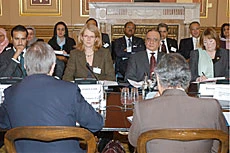
JEDDAH, 5 March 2005 — The private sector continues to play a tremendous role in mending fences with the West. In the recent Saudi-British conference in London titled “Two Kingdoms: Facing the Challenges Ahead” leading members of the Saudi Committee for the Development of International Trade were among the high level delegation that accompanied Foreign Minister Prince Saud Al-Faisal to the conference.
The keynote presentation by Prince Saud encouraged stronger relations between Saudi Arabia and Britain. He said, “We share certain positions of influence and we even share certain common values with each other, combined with a healthy diversity that can be turned into complimentary action to allow us to play more of an active role in world events.” Likewise British Foreign Secretary Jack Straw in his address described the conference as an opportunity to strengthen the partnership between the two kingdoms and meet together the challenges of a changing world.
The Saudi Committee for the Development of International Trade had a major role to play in outlining the future cooperation between Saudi Arabia and Britain and addressing issues of mutual interest. They were involved in organizing high-level negotiations as well as conducting sessions and workshops that were instrumental in making the conference a great success.
In a round table media session the accompanying media delegation headed by Prince Faisal ibn Salman, chairman of the Saudi Research and Marketing Group (SRMG), discussed Saudi and British misconceptions with representatives of Britain’s leading newspapers. The British side was interested to know more about the Saudi media and to learn about how Britain is perceived in Saudi Arabia and whether there is no resentment toward the English in our Saudi press. We explained that contrary to what many may believe there is no animosity toward Britain neither on the government level nor on the people’s level. We also stressed that Saudis appreciate the humanitarian approach of the British soldiers stationed in Iraq. When the scandal of British Army abuse toward Iraqi soldiers came out it did not get as much negative coverage as the American Army abuse of Abu Ghraib Prison. Even the involvement of British troops in the war on Iraq was not viewed with the same level of suspicion as the US Marines were. In general the Saudis have more respect to the way the British deal with the Middle East. British support and cooperation in the field of education, training and trade has so far played an important role since 9/11, 2001, in assisting the Saudi government to upgrade the curriculum and provide training and technical expertise in order to qualify the youth to join the workforce, solve the unemployment problem and bolster the economy. All these aspects are covered by our local media on a daily basis and therefore have a positive effect on the majority of the population.
During the meeting we explained to our media counterparts in Britain that Saudis are not enemies of the West and resent the fact that some elements in the Western media continue to portray us as such. Baseless allegations against innocent Muslims continue to dominate the news and the attack against Arab and Muslim culture is spreading under the pretext of fighting terrorism.
At the end of our meeting we both agreed that we needed to avoid media sensationalism if we were to foster understanding and cooperation between our two kingdoms.
Elsewhere in Europe and the US striking headlines against Saudi Arabia continue to be a popular trend, no matter what positive strides the Kingdom undertakes. Some Western politicians and newspapers still resort to distorting facts and inciting public opinion against the Muslims, demonizing their faith and labeling all as terrorists. Take the case of the Hungarian prime minister who described the Saudi football team as Arab terrorists and praised the Hungarian team for defeating the Saudi terrorists, or Joel Mowbray, an American columnist and media personality, who recently accused Saudi Arabia of harboring terrorists and described it as a land of ignorance and a threat to the American people on American prime time TV. Moreover the US media constantly criticizes the Saudi government for not adopting democracy and the US administration is threatening to impose Western-style democracy to the whole region. Well, there is a lot more to democracy than the ballot; it includes a free press, a policy on human rights and civil liberties as well as a strong base of stable institutions. Saudi Arabia is currently active in acquiring these prerequisites. Saudi Arabia may not have a Western-style democracy but is working hard toward providing citizens with a better standard of living and a secure environment. It is upgrading the educational system, providing job opportunities, improving the status of women pursuing social and economic reforms and addressing the issues of human rights and building a civic society. After all in the final analysis what really matters to us all is to achieve prosperity and to enjoy peace and security. US support and assistance to help us achieve our goals would be highly appreciated.
We may all strive to achieve the perfect society; however every system has its flaws and there is no perfect society that exists today. In the West it is not the people who collectively design their nations’ direction but, industry, business, and politicians with an agenda and of course with the assistance of the presumed free media. We have seen how most of the British public as well as many Americans were against the invasion of Iraq. Millions took to the streets demonstrating against the war. Did they have a say? Many Western journalists are paid by the powerful to manipulate the minds of the common man and woman on the street. Some Politicians are using the media to sway public opinion in favor of their policies. The majority of good people in the so-called Western-style democracy is unable to run for government office due to lack of funds and would always be discredited by a bought media that is only interested in sensationalism and selfish gains.
Having said that I must acknowledge the Western journalists of conscience who have been vocal all along defending the truth and criticizing governments and politicians for pursuing the military path and adopting policies that are detrimental to peace and escalate tensions to create more wars and conflicts. People like Robert Fisk, Linda Heard, John Pilger, Patrick Seale and many others who are powerless against the politicians with the power to dictate the course of events.
In an effort to foster friendly relations between Saudi Arabia and the US, the Saudi Committee for the Development of International Trade a few months back organized one of many outreach programs to counter the smear campaign conducted against the Kingdom. As part of the Saudi delegation, we met with American community leaders and visited several religious institutions in the US. We were overwhelmed with the warm reception and understanding that we received. We were able to communicate to them that it is the American policies toward the ME that is the cause of the Arab and Muslim rage directed against them. However some elements in the American media have their own hidden agenda and are bent on creating a wedge between the US and Saudi Arabia in particular and do not want to see better relations between the two countries. However we were heartened by Prince Saud Al-Faisal’s recent statement that the relationship with the US has become healthier recently and that compared to the warmth that existed before Sept. 11 we are reaching gradually the level of comfort we enjoyed before.
In another venture to foster friendship between the American people and the Saudis, the Jeddah Chamber of Commerce and Industry is also organizing a Saudi-American Interactive Dialogue titled “Fostering Community Building Bridges of Understanding and Cooperation.” The event will seek to create an open and honest dialogue between Americans and Saudis. The dialogue will address two topics: The role of religion and social responsibility in community development and creating a responsible media.
There are misconceptions on both sides and academics, journalists as well as community and business leaders can play an important role in creating a better understanding between the two cultures and address the issues that divide us today.
Saudi Arabia has been the target of continuous international media attacks since Sept. 11, 2001. The tremendous work and effort that has been exerted to promote the image of Saudi Arabia in the international community by the captains of business and industry during the past few years should be commended and the role of the chambers should be highly appreciated.
(Samar Fatany is a radio journalist. She is based in Jeddah.)