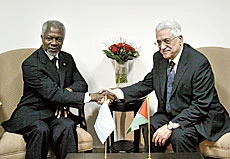
RAMALLAH, 15 March 2005 — The world is determined to push ahead with fresh Middle East peace moves and create an independent Palestinian state, according to UN Secretary-General Kofi Annan who met Palestinian President Mahmoud Abbas in his Ramallah headquarters here yesterday.
Palestinian groups said they were ready for a formal cease-fire, seen as a crucial precursor to road map negotiations on Palestinian statehood, if Israel freed 8,000 prisoners and pulled back forces in the occupied West Bank.
After his talks with Annan, Abbas said he expected to win militants over to a formal truce, cementing a tacit deal prone to violations, in talks with them today in Cairo.
“We hope the dialogue in Cairo will yield positive results because the conditions are right among all parties concerned,” he told reporters in the West Bank city of Ramallah.
But Israeli Prime Minister Ariel Sharon rejected the truce bid, repeating Israel’s demand under the US-backed road map peace plan for Abbas to dismantle militant groups rather than negotiate with them.
Abbas, a moderate elected in January to succeed Yasser Arafat, has vowed to try to control such groups but prefers to do so through dialogue rather than confrontation.
After meeting Annan, Abbas arrived in Riyadh for talks with Saudi leaders.
Israel has also delayed a promised pullback from West Bank cities in a dispute over its scope and has balked at freeing many jailed militants it says were involved in killings of Israelis during a four-year armed uprising.
Israeli and Palestinian officials met in Israel to try to resolve these issues yesterday.
Abbas and Sharon issued mutual cease-fire declarations at a Feb. 8 summit. But sporadic violence has persisted, including a Feb. 25 Palestinian bombing that killed five Israelis and slowed post-summit diplomatic momentum.
Annan, on his first visit to the region in almost four years, went to the West Bank after talks in Jerusalem on Sunday with Sharon.
Annan told reporters he intended to promote the long-stymied road map plan for a viable Palestinian state in the West Bank and Gaza alongside a secure Israel.
“The international community is determined to work with both sides to press for the implementation of the road map and work to ensure that the day when a Palestinian state is established side by side with Israel will not be (far off),” Annan said.
Abbas is keen to launch road map talks soon but Sharon is preoccupied with looming resistance by diehard settlers to his plan to evacuate them from Gaza, and has vowed to keep much larger West Bank settlements he views as strategically vital.
Sharon aims to withdraw from Gaza this summer but to do so he must first outwit rightist foes now blocking a parliamentary majority for the 2005 budget. He has to pass the budget by March 31 to escape snap elections that would stall the pullout.
Meanwhile, the final route of Israel’s wall around Jerusalem will encompass large areas claimed by the Palestinians, including their intended capital and the biggest Jewish settlement in the West Bank, Israeli officials confirmed yesterday, prompting Palestinian complaints that Israel is drawing its borders unilaterally.
The route would also place a holy site in the Palestinian town of Bethlehem on the Israeli side of the wall, while leaving a Palestinian refugee camp in Jerusalem encircled by a separate fence, the Israeli officials said.
Israel began building the wall in the West Bank two years ago, saying it was needed to keep out Palestinian attackers.
Palestinians say the structure, which dips into the West Bank, is an attempt by Israel to impose a border without waiting for a peace deal.
The section around Jerusalem is especially sensitive. The Palestinians hope to establish their capital in East Jerusalem, a traditional Arab commercial, religious and social center. Prime Minister Ariel Sharon convened a meeting of senior Cabinet ministers late Sunday to discuss the final route of the wall, which had received Cabinet approval last month.
— With input from agencies