BEIRUT, 20 March 2005 — Investigators searched the rubble of a car-bombed building in Beirut for clues to an attack yesterday that boosted fears of renewed bloodshed in Lebanon and complicated already troubled negotiations between rival political groups over the formation of a new government.
Reacting to the continuing crisis at home, President Emile Lahoud canceled his plans to attend tomorrow’s Arab summit in Algeria.
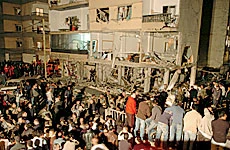
The explosion wounded nine people and devastated an eight-story apartment building in the largely Christian New Jdeideh neighborhood shortly after midnight, sending panicked residents in their pajamas into the street. It blew off the fronts of some structures, left a seven-foot-deep crater, damaged parked cars and shops and shattered windows for several blocks. The motive behind the attack wasn’t immediately clear.
In response, the army announced stricter measures against any security violators.
“The army will not allow that freedom of expression be abused in order to harm security and stability,” a military statement said.
The bomb came amid the withdrawal of Syrian troops to eastern Lebanon and Syria after a 29-year presence in this former civil war-ravaged country.
The redeployments followed intense international and local opposition to Syria’s role in Lebanon since the Feb. 14 assassination of ex-Premier Rafik Hariri in a massive bombing that killed 17 others.
It also played to concerns among some Lebanese that pro-Syrian elements might resort to violence to show, in their view, the need for a continued presence by Damascus forces. Hundreds of thousands of Lebanese have taken part in demonstrations for and against Syria since Hariri was killed. The anti-Syrian protests have featured large numbers of Maronite Christians.
Opposition leader Walid Jumblatt warned there could be more car bombs and assassination attempts but urged calm. “Car bomb messages do not threaten our national unity,” he said in a speech to supporters at his mountain palace of Mukhtara, southeast of Beirut.
Police closed all entrances leading to the blast site and blocked onlookers from nearing the devastated building. After sunrise, residents began clearing debris and inspecting their damaged shops and homes.
Security officials said on condition of anonymity the blast was caused by a time bomb placed underneath a car belonging to a Lebanese-Armenian resident of the damaged building. It was unclear where the car owner was or why the bomb was placed under his vehicle.
Earlier, witnesses said the car attempted to stop in front of a bingo hall, but security guards asked its driver to move along. The driver then parked the car a short way down the road. Minutes later it exploded.
Lahoud, a close Syrian ally, made no mention of the attack, saying only in a statement that Lebanon was experiencing “exceptional circumstances” that required “immediate and direct dialogue” between opposition and pro-government groups.
He also offered to host immediate talks between Lebanon’s various political factions to protect national interests “at this critical stage.” Opposition legislator Fares Soeid dismissed the invite, saying: “It’s too late. This subject is closed” in a televised interview.
Hezbollah leader Hassan Nasrallah suggested the opposition “may be betting on the current situation in the country and thinking it can score a victory.”
“But I say to them that their evaluation is not accurate and their calculations are incorrect. Lebanon can only be salvaged through coming together to hold a dialogue and reach an agreement,” Nasrallah told reporters following a meeting with Grand Mufti Mohammed Rashid Kabbani, the spiritual leader of Lebanon’s Sunni Muslim sect.
— With input from agencies