
Here is a well-known couplet in Urdu that asks, “Where has the veil gone?” and then replies that it has “fallen over the eyes of men.” Today, a veil of ignorance has fallen over the eyes of men, especially post-9/11. It is more dangerous than the Iron Curtain which Sir Winston Churchill was first to mention in a famous speech at Fulton, Missouri in 1946. All the debris of the Twin Towers in New York, the concrete, the iron, and steel has been used to build walls and curtains which exclude Islam and Muslims and in veiling eyes against truth, justice, freedom, tolerance, peace and understanding.
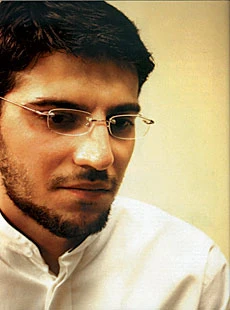
Fortunately response is forthcoming. Sami Yusuf, a 24 years old Briton of Azeri origin, is responding through his nasheeds, a popular form of music that praises the Prophet Muhammad (peace be upon him) and glorifies God.
Born into a musical family, his initial musical training came from his father who was a composer, poet and musician. “I come from a musical background and it would be fair to say that music has played, and still plays, an integral part in my life. My whole family is musical, including my two nephews and about 60 cousins!” He went on to say, “My father taught me an old Persian proverb that basically means however much people might think they are good, or are arrogant because of what they know, they should remember that there are always people who are better and who know more than they do.”
After composing for a time, Sami received a scholarship to study at the Royal Academy of Music in London. He considers himself a professional musician, composer and producer, and has been producing and composing for the past six years. He believes that for the average westerner to receive this beautiful message with sympathy, or at least without enmity or malice, “We must reach out to them and speak to them in their own language and culture!” He explained that art has always played a very important role in introducing the richness and wealth of Muslim civilization. Muslims throughout history have been the pioneers of their time and explored the secrets and mysteries of this world. Among the arts mastered were music, philosophy, architecture, mosaics, pottery, medicine and mathematics.
“Unfortunately, in recent years, we have seen bigotry and fanaticism creep in and make themselves heard from among the Ummah (the Muslim community). Although they are not widespread, the extremists have loud voices for spreading their narrow-mindedness and ignorance, bringing confusion to many Muslims. I think that for Islam to flourish in the West, it is essential that we become forward thinking and break away from the shackles of bigotry and fanaticism which hold us back,” he said.
“The Azeri people are very spiritual with a deep appreciation of art and beauty. I feel that being an Azeri has certainly helped me appreciate how diverse, vast and colorful the Muslim world is,” he said. He said he gets inspiration from many sources — classical Azeri, Arabic and Persian music as well as poetry from Turkey and the Indian subcontinent.
He released his first Album Al-Mu’allim (The Teacher) in the summer of 2003, and in no time has gone from “who?” to “wow!” As the dedication note on the CD makes clear: “I wanted to remind my brothers and sisters of the message of the Prophet (pbuh) who was sent by God to teach humanity, the moral values of justice, kindness, humility, sacrifice and love.”
The response to the album has been phenomenal. “I’ve received positive comments from Asians, Arabs, non-Muslims, young and old and from so many countries that I have no idea how the album got there! It’s amazing how they can all listen to the same nasheed and enjoy in their own way. I think some tracks are perhaps more appealing than others but generally I think that the title track has been the greatest favorite. My long-term goal is to target a CD at a non-Muslim audience in order to invite them to Islam.”
Sami has renovated the classic inshad and made it appealing in ways that are accessible to the MTV generation. He appeals to those who want to be both devout and trendy. He sings in a mixture of English and Arabic. An artist with a noble cause, his composition, voice, carefully chosen lyrics and devotion to Islam, do not fail to register and make a favorable impression. Going through the fan mail which comes to Sami, who describes himself as “intuitive, curious and always in awe and admiration of the wonders and creations of God,” one cannot fail to notice that the majority shower blessings on the artist and say that he has inspired them to be better Muslims.
Sami’s second CD, Supplication, is now on sale and has also been enthusiastically received.