BAGHDAD, 29 March 2005 — A car bomb killed seven Shiites trekking to Karbala yesterday as politicians worked feverishly to cobble together a government on the eve of a second session of the newly elected Iraqi Parliament. The country’s interior minister said security forces had surrounded Iraq’s most wanted man, Abu Mussab Al-Zarqawi.
The car bomb exploded in Iskandariya, south of Baghdad, on a road leading to Karbala. Nine people were injured.
At religious ceremonies in Karbala and Baghdad last year, more than 130 people were killed by suicide bombs.
Iraqi police have strengthened security in and around Karbala over the past week, fearing attacks.
In apparently related violence, a bicycle strapped with explosives blew up near a police car on the main road from Baghdad to Karbala, killing two policemen and wounding several other police and civilians.
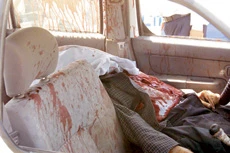
In the Doura district of southwestern Baghdad, police chief Col. Abdel Karim Al-Fahad was gunned down by unknown assailants as he drove to work. His driver was also killed. In an Internet statement, Al-Qaeda claimed responsibility.
Zarqawi’s group claimed responsibility for the killing in a message on a website. It said the Balaat Al-Shuhada police chief “fought God and his prophet (and) displayed his non-belief and his immorality as he attacked Muslims in Doura.”
And in Najaf, south of Karbala, police Maj. Nour Karim Nour was shot dead by US troops after approaching a checkpoint on the wrong side of the road, Najaf’s police chief said.
Interior Minister Falah Al-Naqib said during a news conference in Baghdad: “We have not arrested Zarqawi. He is surrounded in a certain area, and we hope for the best. This operation is ongoing. We hope that the situation will be completely different in Iraq at the end of this year.”
Naqib said Zarqawi was moving in “more than one area,” but he refused to give details.
Efforts to form a government two months after the Jan. 30 elections shuffled ahead, with Shiite and Kurdish leaders — representing the two groups that did best in the ballot — saying they were closer to deciding the top jobs. A two-thirds majority in the 275-seat National Assembly is needed to approve the top government posts, a ratio the Kurds and Shiites only have if they join forces. That mutual reliance has created tensions that have drawn out the formation of the government.
Political sources have said the names of the country’s president and two deputy presidents, as well as the assembly’s speaker and two deputies should be announced at today’s National Assembly meeting, and possibly the name of the prime minister.
With about 30 Cabinet seats to decide, Shiites and Kurds are battling for the most influential ministries, while also trying to ensure that Sunni Arabs, most of whose supporters did not turn out to vote in the election, are not left out.
Ghazi Al-Yawar, a Sunni Arab who is currently Iraq’s president, was suggested by Shiites and Kurds as a candidate for speaker of the assembly. But aides said yesterday he had declined. Politicians were trying to agree on an alternative Sunni Arab candidate for the post. Yawar has said Sunnis, who won only 17 of the 275 parliamentary seats, must retain the presidency to help stabilize the country and ensure their involvement in the political process.
The presidency could still go to another Sunni candidate, Fawaz Al-Jarba, a general in the former Iraqi Army. But Jarba is among the few Sunnis on the Shiite list which won the election and which many Sunnis are wary of.
There are serious concerns the insurgency could get worse if the Sunnis are seen to be marginalized in the composition the new government, and in the leadership of the assembly which will draft a new constitution.
— Additional input from agencies