RIYADH, 29 March 2005 — Somewhere in the Thumama Desert, Saif Al-Badr stands before an assembled crowd of Saudis flaunting a pigeon with strings and a stone attached to its legs. Nearby, perched on a wooden block, is a white-and-gray falcon from Uzbekistan with a hood blocking its vision.
As the SR150,000 bird of prey is unhooded, its disposition changes. From a seemingly docile creature in its cloaked darkness, it transforms into an aggressive hunter, ready to strike its prey with its blinding speed and deadly talons.
Meanwhile, Saif, the falconer, starts swinging the pigeon with the strings wrapped around his hand. The falcon has now sighted its prey and goes after it at full throttle. It swoops to pick up the hapless pigeon, but Saif maneuvers the bird out of its flight path in what looks like mock aerial combat. The only difference, however, is that a tiny propeller plane is pitted against a modern jet interceptor. The spectacle is prolonged for the benefit of the audience. The falcon soars into the sky, follows the same trajectory, and swoops down again only to miss its target through Saif’s evasive action.
After letting the raptor make some futile attempts as part of the air show, he releases the pigeon, which flies unsteadily with the stone dangling below. The chase ends as it is brought down with a mighty swoop at 380 km/h.
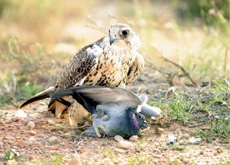
Cheers from the crowd rise to a crescendo. “The impact of such a speed is enough to kill the bird in the air,” Saif told Arab News. With the pigeon clamped by its talons, the falcon sinks its needle-sharp beak into its throat to draw in the blood. Once it has been drained of its bloody content, the falcon proceeds to pluck the feathers that fly all around us. A few minutes later, all that is left is a messy, bloody carcass of what was once cute, throbbing life. Saif, who works for the Riyadh-based Falcon International Co., says falcon hunting is their line of business, besides organizing safaris. “When we receive orders like the present one, we bring falcons and pigeons to put on the dance of death. We organize dozens of such shows every year,” said Saif, who has rubbed shoulders with Prince Sultan, Prince Charles and other members of the royal families of the world.
According to him, the falcon population in Riyadh alone has soared to 50,000 as opposed to 10,000 in the United States. However, the price is determined by the raptor’s characteristics, such as its height, color, wingspan, talon length and other qualities that determine how deadly it will be once it takes to the skies.
“Unlike peregrines, falcons don’t drink water unless they fall sick. They only drink blood and eat flesh,” says Saif, who has been entertaining his clients over the decades. His company owns 10-15 falcons, which are released back into the wild over a period of time.
“Falcons don’t breed in captivity. So as we release these birds, we buy new ones, either locally or from abroad, notably Uzbekistan, Iran, Pakistan and some European countries.”
Although falconry is called the Sport of Kings, it has a great appeal for princes, too. Prince Charles is reckoned to be an expert in this field. “I did a show for him,” Saif said. “He knows a lot about falcons. Prince Sultan is easily the best falconer in the world. Also, the late Sheikh Zayed. He knew a lot about falcons.”