
FROM ON BOARD THE USS DULUTH, 29 March 2005 — More than 20 battleships from 13 coalition countries began massing in the central Arabian Gulf waters since last Tuesday to take part in the Arabian Gauntlet 2005 exercise. This year’s Arabian Gauntlet, which is a maritime exercise that began in 1998 through a US initiative, focused on mine countermeasure exercises.
The Iraqi navy, which is taking part in the joint exercise side-by-side to GCC countries for the first time in more than three decades, is working with navies from the six Gulf states along with Jordanian, Egyptian, Pakistani, US, French, and Australian.
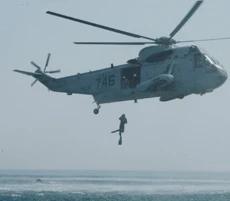
US helicopter mine hunters were the first to be deployed on Wednesday (March 23) to try and locate the suspected mines during the training, but it was divers from Kuwait and Oman navies that got to jump first to deal with and detonate them at sea.
They were followed by US and French divers who detonated similar floating mines. Bad weather hampered the exercise on Thursday (March 24), but it was well back on track on Friday (25). The exercise runs through till today. The exercise is held every two years, with a smaller version of the exercise ‘Arabian Shark’ being held the year in between. The participation of the Iraqi Navy, along with navies from Kuwait, Saudi Arabia, Bahrain, Qatar, UAE, and Oman is seen as sign of the normalization of relations and cooperation between Iraq and its neighbors since the fall of the Iraqi régime.
Iraqi officers held unofficial talks with their counterparts from the coalition on board the amphibious transport ship USS Duluth — which has been acting as the command ship for the exercise — in the central Arabian Sea. The Iraqis are only observers in this year’s exercise, but according to Operational Commander of Umm Al Qaser Base in the Iraqi Navy, Capt. Adel Hafith, they expect to be full participants in next exercise.
He added that the Iraqi Navy was taking on more security responsibilities as they develop. Chief of Staff for Operations at Umm Al Qaser Base in the Iraqi Navy, Capt. Thamir Naser, who’s onboard the USS Duluth described the participation as an opportunity for the Iraqi Navy to work with other GCC countries to exchange expertise and develop their skills. “The exercise is also important to help us gain the necessary skills to protect the oil terminals,” he said.
“We are excited to be working with our brothers from the GCC after being cut-off from any cooperation with them for more than 35 years,” he added.
The Iraqi’s had their Khawr Al Amaya (KAAOT) and Al Basra (ABOT) southern offshore oil terminals — which help provide more than 80 percent of the funds for the Iraqi government, and less than ten miles away from the Iranian boarder — fully operational by November last year. The terminals — which pump close to two million barrels of oil daily and operated by Iraqi’s — remain to this date under coalition forces protection, following last year’s April suicide attacks, with the Iraqi navy chipping-in the efforts.
Iraq, which has only 58 km of coastline, is reliant on the ports of Umm Al Qasr and Basra that are located on Shatt Al-Arab, along with its offshore oil terminals as it’s only maritime access to the world to export oil.
GCC officers on board the Duluth who declined to officially give statements to media, unofficially expressed delight over the participation of the Iraqi officers. Officers from both sides were seen holding unofficial talks about the current situation, exchanging views, and observing on-going operations jointly.
“We are happy to see the Iraqi officers here,” one GCC officer said on condition of confidentiality. “We all know that the Iraqi people were not to blame for what happened, since they never had a say in the course of events. They are our brothers and sisters and the social and cultural bonds between us could not be severed. no matter what.”
Commodore of Destroyer Squadron 50, Capt. Hank Miranda, from the US Navy described the exercise as a multilateral surface, air and mine countermeasure training designed to practice maritime security operations with coalition partners and allies in the region.
“Arabian Gauntlet is an excellent training opportunity to enhance the interoperability of coalition and regional allies to deter international terrorist organizations’ use of the maritime environment,” he said. Mission commander of the Pakistani contingent — which is compromised of PNS Shahjahan destroyer, and the two mine counter measure vessels PNS Mujahid and Munsif — taking part in the exercise, Capt. Asif Saleem described the goals of the exercise as something that all nations share concern for.
“The aim of this exercise is to achieve a secure and stable maritime environment,” he said. “This exercise is an effort by regional and coalition partners to reach a better cohesive capability to fight terrorism”. Commander of PNS Shahjajan, Capt. Abdul Aleem PN, said that taking part in the exercise was an opportunity for the Pakistani navy to prepare itself to provide maritime security for off-shore oil platforms after it embarked on an oil drilling program off its shores.
At the end of Arabian Gauntlet, the coalition will evaluate all phases and identify steps to improve any circumstances that deter potential threats and improve techniques that currently protect shipping and prevent other illicit activities.