
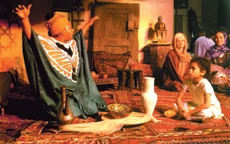
IT would be difficult to find another cultural event in contemporary Britain that turned so many hats (or turbans, for that matter) than the Globe Theatre’s season on Shakespeare and Islam. It was not only an exercise in imagination and creativity but also a bold adventure into our shared humanity: An explosion aimed at blowing apart the restricted understanding we have today of the nature and essence of things great and universal.
If anything the initiative reiterated the power of culture as a factor for the furtherance of cohesion and harmony within communities. In both the souk and the lecture theater what was obvious was the goodwill, the energy and the desire for something better — bigger and grander than the mundane reality we are relentlessly being sold in our everyday existence. For the majority of those who participated in the season, the experience was not only uplifting but everlasting: Who can forget the atmosphere of brotherhood and exchange in the souk? And is it really possible to erase from the memory the deep understanding of our humanity that Shaykh Hamza Yusuf and Dr. Martin Lings shared with Shakespeare?
Okay, so the bard wasn’t really Shaykh Zubair; Romeo and Juliet wasn’t a direct plagiarization of Leila and Majnoon. But who really cares so long as Othello is a great play and the sonnets are a pleasure to listen to.
The season was a source of great joy to everybody except, of course, the usual cultural fascists who forget to grasp the essence of what civilization is all about. No other event to be organized in the foreseeable future is likely to enrich our sense of Britishness as the Globe’s season has done. No other contribution is likely to be as original, as bold or as relevant in the struggle to define British Islam as the Shakespeare and Islam season. So, what next?
We at Q-News have always believed in the power of culture in bringing people together. We are convinced that for Islam to take root prosper healthily in Britain and other Western societies, it is vital that we invest and develop a comprehensive cultural agenda. The aim should be to inculcate in our young the desire for what is beautiful and enlightening for both mind and spirit.
Our communities must be re-educated on producing and appreciating what is beautiful and aesthetically pleasing: For God is beautiful and loves beauty, said our Noble Prophet, peace and blessings be upon him. We need, particularly our young, to reconnect with our rich heritage of arts and crafts, songs and poetry. We need them to know how — when caught in moments of frustration and despair, to seek refuge in prayer and tranquility as well. This year Q-News plans to intensify and focus even more on the project of creating a cultural agenda for British Islam.
In April, Inshallah (God Willing) — we plan to hold a massive mawlid ceremony, a celebration of the Prophet’s birthday, which we hope will be an improvement on a similar event we held ten years ago.
Like all our other events it will be ambitious, inclusive and not a snooze-zone. But it is enough to warn you that the intention, like always, is to share the joy of being alive, kicking and Muslims. And to do so with our relatives, friends and neighbors.
Behind the Season’s immense and unparallel success lies a simple formula: Sincerity, openness and respect. From the beginning the whole project was based on a genuine desire to reach out, to embrace the other and, more significantly, to make it a civilized human endeavor.
Our sincere thanks to Patrick Spottiswoode and his team at the Globe Theatre for their respect, dedication and professionalism. It was a pleasure to work with a group of people who epitomized all the qualities that Islam encourages. We look forward to many more seasons of sharing, civilization and joy.
Patrik Spottiswoode joined the Shakespeare’s Globe when the theater building was just a dream. Now, twenty years later, he reflects on a spectacular year of Shakespeare and Islam.
“On a cab journey to the Globe one morning, I noticed that my driver had prayer beads hanging from his rear-view mirror. I asked him, “Are you Muslim?” For a moment he flinched, afraid of what I would say or what I would do, if he said yes. The driver knew me since he’d picked me up before, but his immediate reaction was of fear. ‘Are you a Nigerian Muslim?” Grudgingly, he said yes. Then I asked, “Do you know Dr. Dawud Noibi?” This time he smiled and brightly replied in the affirmative. I told him that Dr. Noibi — a Nigerian Muslim scholar known for his innovative interfaith work — was speaking at the Globe in three weeks. Everything changed between us and we had a wonderful, animated conversation for the rest of the trip. When I got home that evening, there was a note awaiting from my driver — who had come back sometime during the day -giving me a list of mosques that he asked me to send information about the season to. From a fear and concern, my cab driver had been able to find a way to celebrate and participate in the season. One of my undergraduate students studying at the Globe is an American Catholic who came to the souk and decided at some point in the afternoon to head into the prayer room. She took off her shoes and went to the women’s section. One of the women praying there told her that she needed to tie her hair back and cover her head if she wanted to join. The woman asked my student if she was Muslim. I’m Catholic, she replied. The woman then took her aside and introduced her to the rituals of prayer, explaining what the actions and words meant and why the daily prayer played such a central role in Muslim life. The undergraduate student later told me that it was the most profound experience of her time in London. This young woman had been introduced to a faith and the Muslim woman was able to share and celebrate it with her and build mutual respect. Celebration and understanding were the guiding principles of the Shakespeare and Islam season and I’ve loved the mix activity that brought that about. Who would have thought that the Globe would be lit up, illuminated with beautiful images of the Muslim world taken by photographer Peter Sanders. The theater has never been lit up like that before. We wanted Islam to inform and fill the Globe and it has. We transformed our exhibition area into a lecture hall and hosted Shaykh Hamza Yusuf and Dr. Martin Lings. Hundreds of people came, lining up to hear about Shakespeare, Sufism and Islam. This was a year of “wow” moments.
The souk fed both our intellectual appetite and our aesthetic sensibility. The mix of sixteen talks, beautiful designs and crafts from the Prince’s school, performances from Khayaal — the atmosphere was magical. The individual parts came together beautifully and memorably. I think other institutions will follow our example after seeing how successful this effort has been. Those in the theater and arts community I have spoken to are incredibly inspired by the whole thing.
The aim of the year was to explore the context of Othello. For us at the Globe, using “Shakespeare and ...” is a marketing device to get people interested in the work we do. We have had programs on Shakespeare and Spain, Shakespeare and the Jews.
We know that Shakespeare hadn’t read the Qur’an. We don’t know what his knowledge of Islam would have been. But there was knowledge of an Ottoman threat and of treaties England had with Morocco and the Ottoman Empire against its European enemies. I think we addressed some of the most under-researched areas of the 16th and 17th centuries. It wasn’t really until the works of Nabil Matar and Jerry Brotton that we have really begun to explore the relationship between Islam and Shakespeare’s world and the political and cultural negotiations between Elizabethan England and the lands of Islam. As Nabil Matar has said. most scholarship has made us look westward for an understanding of Shakespeare, when much of his inspiration came from the East.
The arrival of the Moroccan ambassador in 1600 itself was a major theatrical event. It’s not like a modern ambassador who steps off the plane into a limousine, racing to his embassy and getting on with business. The 1600 visit was a grand arrival. It wasn’t just the ambassador, but his whole retinue. It wasn’t just his retinue, it was their clothing. It wasn’t Just their clothing, but the music that accompanied them. I agree with the current Moroccan ambassador that the visit a template for Othello. It was an event rich in sounds visuals that must have blown people’s minds in the 1600.
I think the season is very justified and as a theater organization working in the “now” moment, it is particularly justified. We are using Shakespeare and Islam as a catalyst for exploring the faith now and engaging young Muslims with Shakespeare and the arts.
I love the idea of the Globe being a meeting ground. That’s what it was built for. People came, from Shakespeare’s time until now, to hear ideas and stories bouncing around its rounded walls. It’s a worrying responsibility for this organization — how do we maintain the mission and energy of this work? We want to inspire others and find a less threatening way for someone who is not a Muslim to understand Islam and Muslim issues on a neutral ground.
We have had professors teaching Othello and they’d never been to the mosque. So we took them to a mosque and they were able to ask questions and get answers. I am sure they will never teach the play the same way again. I am not sure how big the ripple will be. We will soon begin our educational outreach program on Othello and Islamic design. We are sending a group of four actors to faith and non-denominational schools to work with kids to explore the story from Othello’s perspective with children playing an active role in the play. The work will culminate with the making of two handkerchiefs — one of love and one of peace —using Islamic designs which so influenced handkerchief design.
We intend to collect all the handkerchiefs of peace and sew them together to create a tent of peace that will be used as a place of storytelling, theater and discussion.