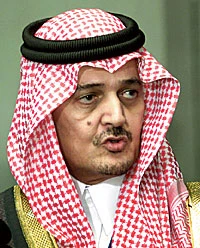
JEDDAH, 18 April 2005 — Saudi Arabia did not sign any deals with France to buy advanced military aircraft during Crown Prince Abdullah’s recent visit to Paris, Foreign Minister Prince Saud Al-Faisal said.
He pointed out that the royal visit was successful in all respects. “Prince Abdullah’s visit was more significant than concluding commercial deals,” the Paris-based Le Figaro newspaper quoted Prince Saud as saying.
The crown prince and French President Jacques Chirac have agreed to establish joint projects and companies and promote trade exchange.
Asked about press reports pertaining to the purchase of planes and manufacture of trains, Prince Saud said such projects were not discussed during bilateral meetings. “No decisions have been taken on these issues and thus we were not able to sign deals during this visit,” he explained.
Prince Saud emphasized Saudi-French military cooperation as well as the capabilities of France in the railways sector. “Nothing can prevent French companies from entering into profitable deals in these areas,” he added.
Echoing a recent statement by Prince Abdullah, he said that the remaining Syrian troops in Lebanon would withdraw within a few days. “Syria has unconditionally accepted the implementation of Security Council Resolution 1559,” he said.
“It is high time for the Lebanese to unify their ranks, form a transitional government and hold elections to strengthen stability in their country,” he said.
Asked about the peace initiative approved by the Arab summit and rejected by Israel and the United States, Prince Saud said: “We cannot say that the US has rejected it because the road map is based on the peace initiative.”
Prince Saud, however, expressed his sadness over Israel’s rejection of the peace plan, “because it is a project that can end the blood-shedding and normalize the situation.”
The Israeli rejection of the peace initiative “is really sad and tragic,” he added.
On developments following the visit of Israeli Prime Minister Ariel Sharon to Washington, Prince Saud said: “There are good and bad things in this context. The recognition of the right of Israel to preserve some of the settlements is a negative matter, but the positive thing is President Bush’s call to end expansion of settlements.”
Prince Saud made it clear that it will be impossible for the Israelis to impose its plans and decisions by force if they are keen on co-existence. He added that the Israelis must act in a manner that makes them acceptable to countries in the region. “Israel has missed a historical opportunity by rejecting the Arab peace plan,” he added.
He called the Israeli withdrawal from Gaza “a step in the right direction” and said it should be followed by other withdrawals as well as implementation of the road map. “If Israel does not plan to implement it, then its withdrawal from Gaza will lead to nothing,” he pointed out.
Speaking about the situation in Iraq, the foreign minister hoped that the factions which had not participated in the general elections would join the political process. Failure to do that will have an adverse effect on the country’s stability.
Asked if he shared views of Jordan’s King Abdallah about the so-called menace of a Shiite Crescent in the Middle East, Prince Saud said King Abdallah had made it clear that his statement in this respect was misunderstood.
“The most important thing is that the Iraqis, with their different factions, should work for the preservation of their country’s unity and independence, and Iraq should never remain a target for any foreign threat,” he said, adding that Iraq is a great civilization which deserves to be respected.
On the Iranian nuclear project, Prince Saud said, “We have clearly told the Iranians that we are working for a Middle East and Gulf region that is free from all weapons of mass destruction, and Iran has confirmed that it believes in this policy.”
Prince Saud added that only the future will confirm if Iran is genuinely going in this direction. “More weapons do not necessarily mean more security,” he stated.