
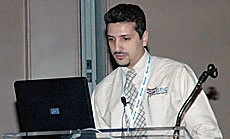
RIYADH, 19 April 2005 — Last Tuesday the curtains fell on the first Gulf Developers Conference 2005 (GDC ’05), organized by Microsoft Arabia with educational patronage from the Saudi Computer Society. The conference brought together over 1,200 IT professionals from the Gulf region for three days. University students were also welcome to attend any of the event’s seminars free. GDC ’05 was considered to be a success by both the organizers and participants, although there was considerable dismay that at the last moment the authorities barred the attendance of the region’s female developers.
“GDC ’05 was a great opportunity,” said Dr. Khaled Al-Dhaher, GM, Microsoft Arabia. “The event featured presentations from international experts, global and local partners and Microsoft’s own consulting team, to ensure that the conference included a wide range of topics to reflect on the diversity of today’s software business.”
He added, “This event coincides with our strategic plan, as we believe in the role that the private sector can play, especially in developing the skills and ability of the society. We are very proud that we were able to organize this event. Different sectors from the industry were able to attend and participate. We at Microsoft believe that our role goes beyond being a software vendor to being a motivator and a leader in helping the Middle East developer’s community grow, so that this region can develop software, that can be exported to the world.”
Planning for GDC started in Fall 2005. Ammar Abu Thuraya, Developer & Platform Lead at Microsoft Arabia, and his team investigated the offerings at other developer’s conferences to get an idea of which technologies were hot and what were the best ways to put on the seminars. Microsoft Arabia reached out across the Europe, Middle East and Africa (EMEA) region to attract the best consultants to speak at GDC. Most of the experts brought to the conference are involved in businesses in the communities where they live and they are also speaking at other conferences. This gave them experience in the best ways to present the material so that it would be interesting and useful for the audience. At GDC there were 48 technical sessions covering all the following tracks: Windows Longhorn, Connected Systems, Web Development, Smart Client, Application Security, SQL Server, Architecture and Portals & Collaboration.
“I would like to thank everyone for their efforts in making this event happen,” said Abu Thuraya. “With the success of GDC, Microsoft Arabia plans to schedule this event annually. We feel that it is important that the developer community understands our commitment to support them locally.”
GDC attracted the attention of many developers in the region. The event was geared toward generating developer excitement by providing early developer access to key platform technologies that have not been released yet (e.g. Whidbey, Yukon) or that are still under development (e.g. Longhorn).
“The whole concept of GDC was born because we wanted to share our new technologies with the local community. We want to give people access to the new Microsoft technologies that are coming up. Why travel abroad to learn about this technology when we can bring the resources here? While giving developers a glimpse of Microsoft’s future vision and technology, GDC also demonstrated the compelling benefits of Microsoft’s current technologies and assured developers that their investments today are connected in a meaningful way to the next evolution of the Microsoft platform,” Abu Thuraya remarked.
There was quite a diverse audience at the conference. Some of the attendees on the first day were technology decision-makers. Others were business development managers. By attending the opening sessions they got a road map, an idea, about some of the upcoming technologies.
“We were also thrilled to see the number of students who attended,” said Abu Thuraya. “We wanted university students and educators to know about our technologies. These technologies could change the way teachers present material and would dramatically enhance the education environment. We have some new technologies that facilitate e-learning and the sharing of knowledge and information. There are also technologies to enable the dissemination of information from lectures and new ways to do homework without the need to resort to handwriting.”
There definitely was excitement in the air at GDC. Some developers mentioned that just meeting in the same place was a novelty. It was also interesting to see experienced developers and managers from enterprises and government agencies interacting in sessions also attended by students studying to enter various technology fields. It was a great chance for everyone to learn something new, exchange ideas and in some cases get a dose of reality. Alongside the seminars was a small exhibition showing some of the new solutions in the market. Abu Thuraya mentioned that one of the reasons for the exhibition was to help the students learn what the market interests are and to put the technology in a real world setting.
“We have been collecting feedback from everyone on how to improve the event,” said Abu Thuraya. “This event is not something we want to show. It’s something we want to share. GDC is just one of the things we are doing to build a developer community. We have other local programs to compliment GDC. This annual event will be a milestone but there will be lots of other offerings during the year.”
Microsoft Arabia has launched a Developers Support Center that will play a major role in supporting the developers’ community in the Kingdom. The support center will be directly involved in supporting, guiding and sponsoring the new IT developers, through providing them with the relevant books, materials and software.
“A developer community is very important. When you talk about software development you are talking about experience. You don’t want this experience to come from any software vendor per se, but you would want it to come from all experiences,” Abu Thuraya explained. “There might be a small company out there, in Abha or Alkhobar, and they’ve got great developers and they are doing a great job. Maybe there will be another developer who wants help from them. So building such a community where they can communicate together, either online, or offline by meeting on a monthly basis, is a great thing. The sharing experience between us and them is what we’re looking for. We want to see what we are doing well and what needs improvement to enhance the software technology. The feedback from this conference and other developer events, I send back to both the regional headquarters and the United States. At Microsoft we don’t develop software based on what we think is good. We develop software based on what people want.”
What local developers definitely want is opportunity and Abu Thuraya is making plans to create a positive future for local talent.
“One thing that the local developers don’t know is that I am working on a program that will be implemented over several years,” he said. “Hopefully with efforts from all the concerned parties in the region, we want to grow specialized expertise locally in areas that the local market needs. This is something that Microsoft Arabia must work on with universities and with other experts. I have met with universities in the past two weeks and some of them were very enthusiastic. I think we may see some new programs launched next year on this basis.”
Abu Thuraya is a young IT professional, full of excitement and enthusiasm about technology from a company that has sometimes been perceived negatively by the local market. I asked him why he was such a Microsoft supporter?
I joined Microsoft eight years ago and at that time I was not pro-Microsoft, really,” Abu Thuraya replied. “Now I know that there is the true image of Microsoft that not a lot of people are exposed to. Internally, Microsoft is changing in many ways based on market feedback. A few years ago we dealt with market concerns on security by changing the entire structure of our development teams. At Microsoft, we want to show people the value of our solutions and help them have confidence in what they are getting. At the end of the day we want them to truly make use of our technology. Yes, Microsoft is a software vendor but we do have a lot of programs that have nothing to do with buying and selling. For example, we have new local initiatives on the education side. I know that all of us at Microsoft Arabia will continue to work to enhance the programs we have and create new programs the community needs. That is exciting and fulfilling for me. For the future, I can see enormous possibilities if we all work together.”
(Comments to: [email protected].)