
Against his concierge’s advice, Afshin Molavi walks from one end of Rabat to the other, discovering a wealth of “human sights” and insights off the tourist’s beaten path.
It’s too far,” the hotel concierge insisted. “You should take a taxi. Trust me.”
But I persisted. “It’s only a one hour walk to the casbah,” I said. “It will give me a chance to get a feel for the city.”
“But there is nothing to see,” he countered. “Only neighborhoods. No sights.”
That clinched it. I was definitely walking.
Sure, I wanted to see the traditional sights: Le Tour Hassan, an enormous minaret dating from the 12th century, the mausoleum of the late King Mohammad V, richly decorated in traditional Moroccan style, the ancient Roman city of Sala Colonia, the Royal Palace and its gardens, and, of course, my destination the Casbah des Oudaias, built into a mountain bluff overlooking the Atlantic Ocean. But first, I wanted to get a feel for the daily rhythms of Rabat, Morocco’s capital city perched on the Atlantic Ocean coastline, just a two hour flight from Paris and about 6 hours from Jeddah. I wanted to walk where Rabatis walked and see what they saw on a Sunday afternoon, which was their day off — they follow the Western calendar.
The concierge, with a show of head-nodding reluctance, handed me a map, and drew out a possible itinerary — straight through the heart of the city, crisscrossing several different rues and avenues in this city founded as a French colonial capital in 1912. “If you don’t stop anywhere,” he said. “It will take you an hour and a half.”
It took me about four hours. There were many interesting places to stop. As I left my hotel, I walked by a grassy stretch where families picnicked. A father threw his infant daughter in the air, both of them laughing hysterically with each toss and catch. I stopped to watch a group of teenaged boys play soccer. Like teenaged boys playing sports anywhere in the world, they taunted each other, cracked jokes, formed cliques, argued over calls, and erupted in riotous, narcissistic celebration with each goal. After one goal, a young man with spiky hair lifted his worn black shirt, pulled it over his head, spread his arms like an eagle, and ran in circles to boisterous laughter.
Continuing through a middle-class neighborhood, I saw white-washed houses blackened with soot. On the wrought iron balconies, clothes hung to dry. A grey cat picked through garbage. Rusted satellite dishes studded the rooftops — a familiar Middle East skyscape.
Suddenly, I heard the thump of drums and the clatter of footsteps just behind me. A swarm of teenaged boys in red shirts rushed past me toward Salle Ibn Yassine. I heard thunderous roars coming from inside the salle and the steady hum of team chants. A soccer game, I thought. Time for stop number two.
As I merged into the crowd, heading for the arena, I flashed back to an episode in Damascus in which I stumbled upon a soccer game just like this one and spent the next two hours learning how to insult the opposing players in “colorful” language that I would never have learned in my Arabic classes.
Once inside the stadium, I saw what looked like an indoor soccer arena with nobody on it — only a cameraman filming the flag-waving crowds. Noticing my confusion, a boy wearing a red shirt emblazoned with the late American hip-hop star Tupac Shakur pointed to the screen above — where two Moroccan teams were doing battle.
“Who’s playing?” I asked, in mangled French, after attempting the same question in mangled Arabic. Many urban Moroccans speak or understand French so for the linguistically challenged, Morocco offers opportunities to be grammatically incorrect in two languages. He made a response I could not understand. So, I did what I normally do in those situations: I nodded my head, feigning comprehension. “Shookran,” I said, before slipping out quietly, as hundreds more young men streamed inside the stadium.
Indeed, “the young man” is another feature of the Middle East landscape widely evident to those who stray off the tourist circuit. In Morocco, they are simply everywhere, leaning up against walls, playing soccer, walking in threes and fours, cleaning cars, hustling tourists, fighting traffic in taxis. The Middle East is one of the youngest regions in the world. More than half of all Arabs and Iranians are under 21 and nearly two-thirds are under 30.
Across the street, I stopped in a cafe. Smoke drifted through the air. A middle-aged, mustachioed man played a pinball machine. Small clusters of men sat around tables, plates of olives before them. All heads were fixed on a scratchy TV in the corner — the soccer game again. “We are crazy for soccer here,” a waiter in a stained white shirt and crooked black bow-tie told me. “You should have seen the city when we won the Africa Cup.”
It’s sometimes easy to forget that Morocco is technically a part of Africa and not the Middle East or even southern Europe The newsstands every few blocks, however, remind you: Along with Arabic and French newspapers, Africa specialty magazines — Jeune Afrique, African Manager and The New African to name just a few — tell stories of South African business success, Tony Blair’s new action plan for Africa, and the spat between Secretary of State Condoleeza Rice and Zimbabwean President Robert Mugabe, who called her “that little girl of slave ancestry.”
Near the Rabat train station, I spotted my first tourist hustlers. Unlike popular destinations such as Marrakesh, Fez, and the gritty commercial city of Casablanca, tourists can walk throughout Rabat virtually unmolested by the “Hello, my friend” brigades.
I sat on a nearby bench and watched one young man in jeans and gelled hair approach several Western back-packers. “Buon Giorno,” “Bonjour” “Hello, my friend.” He spared me. Perhaps because I sort of looked like him: brown hair, brown eyes and, on this particular day, a three day beard. Inside the station, I saw another familiar Middle Eastern scene: An elderly man with wizened, sun-baked skin and sad eyes in a blue frock coat methodically sweeping the floor.
I continued walking, veering onto the splendid Muhammad V Avenue, a wide boulevard in typical French style. Fashionable Rabat lay before me. I walked by patisserie windows stacked high with Moroccan sweets, the stunning red brick Parliament building, chic Rabat ladies out for a stroll, and the exquisitely designed Bank Al-Maghreb, with its ornate wooden doors and Islamic arches. I also saw my first beggar - a rare sight in Rabat. A slight boy with mottled brown hair approached me, putting his hand to his mouth. I bought him a sweet.
Stopping to rest on a park bench, I struck up a conversation with three Moroccan university students — Adil, Hasna, and Nezhna. When they saw me reading a piece about Condoleeza Rice and Mugabe in the New African, Hasna said: “It is great to have a woman foreign minister.” The other two agreed, but Adil asked me: “But, isn’t there discrimination against blacks in America?”Adil asked me how long I was staying. “Verdi’s Rigoleto is playing at the National Theater next week,” he said, not without a hint of pride.
It was now dusk, and I was only halfway to the Casbah so I trudged on. Just a few minutes from the Casbah, I spotted a chubby little girl in a coarse dress licking an ice-cream cone and holding her grandfather’s hand. The elderly man walked with a cane. He wore an ill-fitting suit and a fedora hat — (he looked like my Iranian grandfather who never appeared in public without a suit). The girl twirled the cone in the air precariously until, suddenly: Splat. The ice cream fell on the ground.
She stopped, looked down, crinkled her eyebrows, looked up at her grandfather, and burst into tears. Her grandfather pulled a white handkerchief from his jacket, squatted down with noticeable difficulty, and wiped the girl’s tears. They then turned around, walking back toward the ice cream parlor.
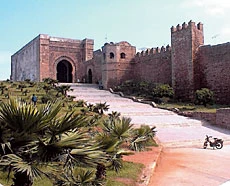
Approaching the Bab Oudaia, built in the late 12th century, the massive gate to the Casbah, I knew I was nearing my destination. It was just after dusk. Strobe lights lit the long, wide stairway leading up to the Bab. Once inside, I turned onto Rue Jamaa, the main thoroughfare, and walked past houses built mostly by Muslim refugees from Spain in the 15th century.
A group of European tourists crowded around the shops which sold Moroccan bric-a-brac at exorbitant prices. A tourist hustler approached me with one of the oldest tricks in the book: “It is forbidden to walk this way at prayer time,” he said in French. “It’s only for Muslims, but I will take you.”
I just smiled and kept walking. The Casbah’s white-washed mud homes with turquoise doors and ornate wrought iron balconies give it the feel of a sleepy Meditteranean village. It also has the most pleasant café in town: Café Maure, where you can sip mint tea and watch the foamy white waves or stroll in the nearby Andalusian gardens.
Tired and thirsty, I took a spot in the corner of the Café, which held a smattering of Japanese and European tourists, ordered a mint tea and a cold water, and watched the seemingly endless ocean in the distance. The tea was good, the view breathtaking, the air pleasant, but I suddenly wished I was back in the café or on a park bench on Avenue Mohammad V, watching Rabat stroll by me. I wondered who won the soccer game. Did the boys in the red shirts spill out onto the streets to celebrate? I also wondered if the little girl got another ice cream cone?
The concierge was right. It certainly was a long walk. But he was wrong on the more important point: There were plenty of sights to see.