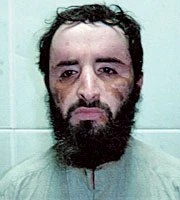
ISLAMABAD, 5 May 2005 — Abu Farraj Al-Libbi, a top Al-Qaeda terrorist, described by US counterterrorism officials as the group’s No. 3 man and a close confidant of Osama Bin Laden, has been arrested after a firefight in northwestern Pakistan, officials said yesterday.
Pakistani commandos nabbed Al-Libbi after a shootout at one of his hardscrabble hide-outs, and jubilant government officials said yesterday his arrest after months of frustration would help in the hunt for Bin Laden.
In Washington, President George W. Bush hailed the capture of Al-Libbi as a “critical victory” in the battle against Al-Qaeda, and others said it was the greatest blow to the terror network in more than two years.
In Islamabad, Pakistani Information Minister Sheikh Rashid Ahmed said the arrest Monday had already produced a treasure trove of intelligence, and predicted more breakthroughs to come.
Al-Libbi, Al-Qaeda’s alleged operational planner and Pakistan’s most wanted man, was the main suspect behind two 2003 assassination attempts against President Pervez Musharraf. He is likely to face the death penalty in Pakistan if convicted.
A Pakistani intelligence official said 11 more terror suspects — including three Uzbeks, an Afghan and seven Pakistanis — were arrested before dawn yesterday in Pakistan’s Bajor tribal region. The official, who spoke on condition of anonymity, would not say what prompted authorities to launch the raid, or whether it was linked to Al-Libbi’s capture.
“This is a very important day for us,” said Sheikh Rashid, the information minister. “This arrest gives us a lot of tips, and I can only say that our security agencies are on the right track” in the hunt for Bin Laden. “This man knew many people and many hide-outs.”
Al-Libbi was arrested along with another foreigner after a firefight on the outskirts of Mardan, a rough and tumble town 50 kilometers north of Peshawar, capital of the North West Frontier Province.
Four Pakistani intelligence officials told AP on condition of anonymity that Al-Libbi — who’s believed to use at least five aliases — was one of two foreigners arrested in Mardan on Monday. The second man has not yet been identified.
Bush said the capture of Al-Libbi, a native of Libya, “represents a critical victory in the war on terror,” and he praised the Pakistani government and Musharraf for the arrest.
“Al-Libbi was a top general for Bin Laden,” Bush said. “He was a major facilitator and a chief planner for the Al-Qaeda network. His arrest removes a dangerous enemy who is a direct threat to America and for those who love freedom.” Bush added, “We’ll stay on the offensive until Al-Qaeda is defeated.”
US officials said the arrest was the most significant since the March 1, 2003 capture of Khalid Shaikh Mohammed, also in Pakistan. They said it was the result of months of close cooperation between Pakistan and the CIA’s most famous division, its clandestine service.
They said the Pakistanis captured Al-Libbi through human intelligence — or traditional human spying, but would not say whether the source or sources of the information that led to his capture were working with US or Pakistani intelligence.
One Pakistan intelligence official said authorities were led to the hide-out by a tip that foreigners had been spotted in the area. Another acknowledged that information from the Americans helped Pakistan plan a well-coordinated operation, but he said that Pakistan also obtained intelligence from militant suspects it arrested months ago.
He said Al-Libbi had differences with Uzbeks and other militants who had been reluctant to accept him as a leader, hinting at a possible rift within Al-Qaeda’s ranks.
A US counterterrorism official, also speaking on condition of anonymity, said Al-Libbi was behind only Bin Laden and Egyptian Ayman Al-Zawahiri in Al-Qaeda’s hierarchy.
Pakistani Interior Minister Aftab Khan Sherpao said the US government was offering a $10 million bounty for information leading to Al-Libbi’s arrest.
— With input from agencies