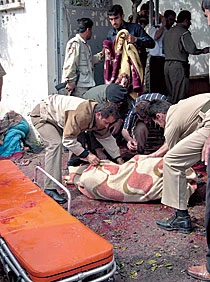
BAGHDAD, 5 May 2005 — At least 60 Iraqis were killed and 150 wounded in Arbil yesterday when a suicide attacker carrying hidden explosives set them off while standing in line outside a police recruitment center with scores of job applicants, the US military said.
Militant group Ansar Al-Sunnah claimed responsibility for the attack in the Kurdish city, saying in a statement posted on the Internet, that it was in revenge for Kurdish cooperation with US forces. The same group took credit for a 2004 twin suicide bombing also targeting Kurds in Arbil that killed 109 people.
At least seven cars parked near the center were destroyed by the blast in an upscale neighborhood that includes the Sheraton Hotel.
Several nearby buildings were damaged. Pools of blood formed on the street outside the center as ambulances and cabs raced to the chaotic scene to take casualties to local hospitals in the city, which is 350 kilometers north of Baghdad.
One hospital became so crowded with wounded Iraqis that staff members used a loudspeaker to give the names and room numbers of the victims to the distraught relatives who rushed there.
But US Navy Chief Petty Officer James Drake said there were conflicting reports about whether the blast was caused by a man carrying hidden explosives or a car bomb. The claim of responsibility by Ansar Al-Sunnah also said its attack involved a suicide car bomb.
The attack appeared to be the deadliest by insurgents in Iraq since Feb. 28, when a suicide car bomber struck a crowd of police and National Guard recruits outside a medical clinic in Hillah, south of the capital. That attack, which killed 125 people and wounded more than 140, was the single deadliest-ever in the insurgency.
In Arbil, police Capt. Othman Aziz said an Iraqi man had stood among dozens of recruits who were in line outside the two-story building, where every entrant is searched by guards. Shortly before reaching the entrance, the attacker detonated himself, Aziz said.
Iraqi civilian Hawra Mohammed, 37, said he had just dropped his brother Ahmed, 32, off at the center to apply for a job and driven away when the explosion occurred.
When Hawra raced back, he found his brother lying in a street, bleeding and unconscious. But Ahmed soon began to move.
“I lifted my brother onto my shoulders and took him to a nearby hospital,” Hawra said in an interview. “The blood on my shirt is my brother’s.”
Hawra said he nearly fainted at the sight of dead bodies outside the recruitment center, and that many of the victims were unemployed, just like his brother, and wanted to earn money as policemen.
Militants have stepped up their attacks across Iraq in the last week, often targeting convoys of US and Iraqi troops, and Iraqi police on patrol or at recruitment centers.
A key goal of US troops is eventually to train enough Iraqi security forces to reduce the role now being played by the Americans in fighting the insurgency.
In its claim of responsibility, Ansar Al-Sunnah praised the attacker as a martyr and a “heroic lion” for setting off a blast that tore many of the recruits to shreds.
The group said the attack was revenge against Kurdish security forces that have “bowed their heads to the Crusaders and raised their spears against the Muslims and fought alongside the Americans.”
Elsewhere, the US military said yesterday that two American soldiers were killed in separate roadside bomb attacks in Baghdad the day before. Those explosions, and the Arbil blast, raised the death toll from a week of insurgent-related violence in Iraq to nearly 200.
Little information was immediately available about the attacks on those two US military convoys, as American forces took time to notify the victims’ relatives.
In Baghdad, two legislators from Iraq’s Kurdish and Sunni minorities, condemned the attack in Arbil.
“This is a horrible crime and a massacre,” Kurdish legislator Fouad Massoum said in an interview outside the National Assembly. “Cooperation between the people and the security forces is necessary to fight terrorists like Mussab Al-Zarqawi and Ansar Al-Islam, who are the enemies of Iraq.”
Mohsin Al-Jarwa, a Sunni lawmaker, said: “This is an inhuman operation, killing the sons of the land who were coming to protect Iraq. I don’t believe those who carried this out were Iraqis. Iraqis don’t kill Iraqis, and I strongly condemn this terrorist act.”
In Baghdad yesterday, Prime Minister Ibrahim Jaafari resumed talks aimed at resolving a dispute among Sunnis and Shiites over seven unfilled positions in the new government’s 37-member Cabinet, including the key oil and defense ministries.
On Tuesday, the first democratically elected government in the history of Iraq was sworn in, and Jaafari, a Shiite, pledged before a half-empty Parliament that he would unite the country’s rival ethnic factions and fight terrorism. But the partial Cabinet fails to give the country’s disaffected Sunni minority, believed to be driving the insurgency, a meaningful governing stake.
Meanwhile, an Australian task force arrived in Baghdad to work for the release of Douglas Wood, a kidnapped Australian citizen.
— With input from agencies