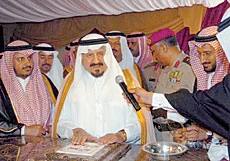
JEDDAH, 5 May 2005 — Prince Sultan, second deputy premier and minister of defense and aviation, yesterday laid the foundation stones for two major hospitals — a 500-bed specialist hospital and a 160-bed Saudi-German Hospital — in Hail. The total cost of the two projects is estimated at SR330 million.
Prince Sultan earlier inspected the plans and designs of the specialist hospital, which is estimated to cost SR170 million, the Saudi Press Agency said. He also examined a model of the new Saudi-German Hospital, which will cost SR160 million.
Addressing the attendees at the foundation stone ceremony, Health Minister Dr. Hamad Al-Manie thanked Prince Sultan for having find time to dedicate the two hospital projects. He said the new specialist hospital would provide advanced health services to the people of Hail.
Prince Sultan also witnessed the signing of two agreements to train and employ 290 Saudis at the two hospitals. The ceremony was attended by a large number of princes and senior officials including Madinah Governor Prince Muqrin and Hail Governor Prince Saud ibn Abdul Mohsen and Dr. Khaled Batterjee, deputy chairman of Saudi-German Hospitals Group.
Governor Prince Saud expressed his happiness over Prince Sultan’s visit to Hail, an agricultural region, and said it would boost the region’s overall development and that the government has already allocated SR1.3 billion for various welfare projects in the region. He said Prince Sultan would also visit the newly established College of Technology in Hail.
Also yesterday, Prince Sultan laid the foundation for the Prince Salman Center for the Care of Handicapped Children in Hail and donated SR10 million to the center, one of the projects of the Disabled Children’s Association (DCA).
Since ancient times, Hail has been a magnet attracting people from all over the world. Rock carvings and petroglyphs provide evidence of human habitation here stretching back more than 18,000 years. What has brought so many people to Hail is water.
Situated at the southern fringes of the great Nafud Desert, one of the most inhospitable places on earth, the Hail valley is surrounded by the Jabal Shammar mountain range. Artifacts indicate the presence of permanent settlements of farmers in the Hail valley more than three thousand years ago.
In 1932, Hail entered a new chapter in its history. After unifying the fractious tribes of the Arabian Peninsula and subsequent founding of the modern Kingdom of Saudi Arabia that year, King Abdul Aziz moved swiftly to end the instability that prevailed in much of the peninsula. With travel and commerce made safe and the introduction of programs to develop the region, Hail soon began to blossom as it had never before. With the infrastructure in place, the city rapidly flourished. It now has a population estimated at 150,000, ten times larger than at any time before the modern era. The principal economic activity in Hail remains agriculture.
Today, Hail exports fruits, including citrus, apples, peaches, grapes and olives, as well as dates and grains. Hail’s farmers have managed to develop new strains of wheat, barley and fruit trees that are better suited to the region’s climate and produce higher-quality products at greater volumes.
Whereas agriculture has traditionally been the only activity in Hail, the modern city now has a dynamic industrial and commercial sector. Today, there are more than 2,000 companies on the roster of the Hail Chamber of Commerce & Industry.