LONDON, 6 May 2005 — Tony Blair won a historic third term as prime minister in British general elections yesterday, an exit poll said. However, his Labour Party will have a reduced parliamentary majority of 66, down from 161 last time, according to the poll for main television broadcasters the BBC and ITV.
The exit poll forecast Blair’s Labour won a 37 percent share of the vote, with the main opposition Conservatives on 33 percent and the Liberal Democrats, who opposed the Iraq war, on 22 percent.
“There is going to be a Labour government,” Deputy Prime Minister John Prescott insisted on BBC Television.
Counting in 645 parliamentary districts was continuing through the night, and the winner would not be officially confirmed at least until this morning. Blair’s campaign for re-election was dominated by a furious debate about his credibility in the wake of the divisive Iraq war. A reduced majority could raise questions about his ability to complete his third term.
Despite the convention that the parties do not campaign on polling day, Prescott used e-mail and Tory leader Michael Howard hit the telephone throughout the day in a final bid to rally voters.
With Labour desperate to persuade their supporters to turn out and vote, particularly in the marginal constituencies which form the key battleground of the election, there was no silencing Prescott.
Labour circulated a mass e-mail, in the name of the deputy prime minister, urging the party’s supporters to get out and vote. In the e-mail, Prescott again argued that Labour supporters who fail to cast their vote, or who register a protest vote with the Liberal Democrats, would effectively be voting for the Conservatives.
After a month of traveling the length and breadth of the country in the quest for votes, the three main party leaders know their fate now lies in the hands of the electorate.
In the end, turnout could be crucial. The last general election in 2001 saw a turnout of 59 percent — the lowest since the troops returned home in 1918 at the end of the World War I — and there were fears of a similar poor show this time.
Labour strategists feared that disaffected supporters, unhappy over the Iraq war, could simply stay at home or cast a protest vote for the Liberal Democrats.
The uncertainty over the result was heightened by the large numbers of undecided voters, with the final opinion polls suggesting more than one in four may be leaving it until the last minute to make up their minds.
The unpredictability has meant that despite his huge Commons majority and seemingly comfortable opinion poll lead, Blair has been warning supporters they are in a “tough and tight” race. “I nearly changed my vote but in the end I stayed with Labour,” said Carol Foskew, 59, who remained loyal to Labour because of some of its social policies.
“I didn’t vote Labour this time because of the war, and because that man (Blair) smiles a lot but tells you lies,” said Cecil Hardy, 76, a Labour supporter in Braintree, northeast of London, who switched to the Liberal Democrats — the only party that did not support the war in Iraq.
Conservative hopes hinged on districts like Braintree, which Labour won by a scant 358 votes in 1997. But the Conservatives faced stiff challenges in some areas from the Liberal Democrats, who fished for protest votes from alienated Labour supporters who could not stomach the Conservatives.
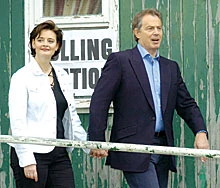
Blair, seeking to become the first Labour Party leader to win three straight elections, picked up two new voters yesterday — his sons Euan, 21, and Nicky, 19, who were voting for the first time. They voted with their parents in the village of Trimdon in Blair’s northeastern English district.
Police officers were patrolling key sites across the capital, but authorities said there were no specific terrorist threats.
In New York, two small makeshift grenades exploded early yesterday outside the building housing the British Consulate, causing slight damage to the building but no injuries, authorities said.
— Additional input from agencies