WASHINGTON, 8 December 2005 — In a case closely watched as a key test of the Patriot Act, a former university professor accused of helping lead a Palestinian terrorist organization was acquitted Tuesday on nearly half of the charges against him, and the jury deadlocked on the rest.
The verdict dealt a blow to one of the federal government’s first major courtroom tests of the expanded search-and-surveillance powers authorized by the controversial Patriot Act, which was enacted shortly after the terror attacks of Sept. 11, 2001.
Sami Al-Arian, 47, who taught computer engineering at the University of South Florida in Tampa, smiled, then put his head in hands from relief after the federal jury found him not guilty on eight of 17 counts — including conspiring to murder and maim people outside the United States.
The panel deadlocked on charges that he had, among other things, engaged in money laundering and attempted to illegally obtain US citizenship. The trial, lasting more than five months, hinged on the question of whether Al-Arian’s years of work in the Tampa area in support of Palestinian independence crossed the threshold from protected free speech and political advocacy to illegal support for terrorists.
From the mid-1990’s, Al-Arian has been in the spotlight when news coverage of his opposition to the Israeli occupation of the West Bank and Gaza led some critics to label the University of South Florida as “Jihad U.”
After 13 days of deliberation, a federal jury acquitted Al-Arian on charges that linked him to a Palestinian terrorist group that allegedly operated an underground cell in Florida, this included a charge that he conspired with other leaders of Palestinian Islamic Jihad to murder people in Israel.
After serving 33 months in jail awaiting trial and a verdict, Al-Arian was returned to prison and will remain there until prosecutors decide whether to retry him on the deadlocked charges.
The indictment did not allege a connection to Al-Qaeda or to any attacks on US soil, but it was issued — amid considerable fanfare by the Bush administration — within 18 months of the Sept. 11 attacks and as the United States prepared for war with Iraq.
The government also failed to secure convictions against three codefendants with alleged ties to the Palestinian Islamic Jihad, which has claimed responsibility for suicide bombings and other attacks that have killed more than 100 people in Israel and the occupied territories, and is branded by the US government as terrorist organization.
Sameeh Hammoudeh and Ghassan Zayed Ballut were acquitted on all charges. Hatem Naji Fariz was found not guilty on 24 counts, and jurors failed to reach a verdict on eight others. Federal prosecutors had no comment Tuesday on what was, for them, a dismaying outcome after 13 days of jury deliberations and five months of detailed testimony.
US Atty. Paul Perez said he and his staff would review the case before deciding whether to retry Al-Arian, 47. Until then, he will remain in jail.
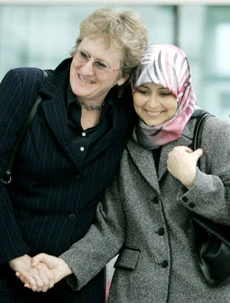
Supporters outside the courthouse cheered when families of the defendants emerged. For the local Muslim community, the verdicts were “a huge relief, and people are just jubilant,” said Ahmed Bedier, director of the Tampa chapter of the Council on American-Islamic Relations, CAIR.
“I’m so grateful to God because He’s the one who showed my husband’s innocence,” said Nahla Al-Arian, the defendant’s wife. She also thanked the jury “that showed there was no case and my husband was innocent.”