
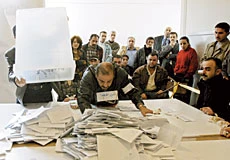
BAGHDAD, 17 December 2005 — The Shiite religious coalition is leading in the polls in Iraq’s five southern provinces, the Kurdish Alliance looks set to win the north and a Sunni coalition leads in a central province, unofficial results showed yesterday after millions of Iraqis voted in elections.
Meanwhile, Iraqi security forces captured Al-Qaeda frontman Abu Musab Al-Zarqawi last year but released him because they did not know who he was, a senior Iraqi official told AFP yesterday.
“He was arrested more than one year ago in Fallujah by Iraqi police,” Deputy Interior Minister Hussain Kamal said. “It seems they did not recognize him, that’s why they released him.” The shadowy Jordanian-born Zarqawi — who only has one leg after being injured fighting for the Taleban in Afghanistan — is Iraq’s most wanted man and has a 25-million-dollar US bounty on his head.
The strong election results for the conservative Shiite United Iraqi Alliance were expected in southern Iraq. However, the UIA might face stiffer competition in urban areas like Baghdad from secular former premier Iyad Allawi, whose list often scored second in Shiite regions.
In Kerbala province, the UIA may have marked its highest score, at 85 percent, according to a source close to the independent electoral commission but not confirmed by the body.
The UIA includes religious parties like the Supreme Council for the Islamic Revolution (SCIRI) and Prime Minister Ibrahim Jaafari’s Dawa party. In Babil province, 70 percent of the electorate went for the UIA, with Allawi managing to scrape up 17 percent, according to an election commission source.
In the Kurdish north, the Kurdish alliance, pairing the Patriotic Union of Kurdistan (PUK) and the Kurdish Democratic Party (KDP), apparently perpetuated its total dominance of the autonomous region’s politics.
In Arbil, the alliance took 86 percent of the votes while the Kurdish Islamic Party took only 3.4 percent, according to a PUK official. In Dohuk, the alliance claimed 76 percent, and 71 percent in Sulaimaniyah.
In the Sunni-dominated province of Salaheddin, the capital of which is Saddam Hussein’s hometown of Tikrit, a Sunni coalition that included the Iraqi Islamic Party led with 45 percent of the votes. It was followed by Allawi at 30 percent, an electoral source said.
More than two-thirds of Iraqi voters turned out nationwide in the country’s landmark election, according to first estimates yesterday, but final results were not expected for at least two weeks.
An international monitoring mission said the election had generally met international standards, and hailed the organizers for meeting a “difficult challenge.” In many regions, voters were thought to give strong local backing to parties or coalitions based on Shiite, Sunni, Turkmen and Christian leanings.
Amid the poll frenzy, the news of Zarqawi’s letoff too made headlines. Zarqawi, 39, is allegedly the mastermind of numerous bombings, armed attacks, hostage murders and other acts of violence in Iraq, and has been sentenced to death in Jordan for the 2002 murder of a US diplomat. “He got away once, he will not get away the next time,” Kamal said. In Washington, a Pentagon spokesman said the US military could not confirm the report.
“That was rumored a year ago and never proved to be confirmed,” Bryan Whitman said. US military forces in Iraq have claimed to have killed or captured a number of Zarqawi’s top operatives and said they have come close to capturing Zarqawi himself on a number of occasions.
“We come close to Zarqawi continuously and at one point in time, in the not too distant future, we are going to get Zarqawi,” Maj. Gen. Rick Lynch, spokesman for the US-led multinational force in Iraq, said last month.

