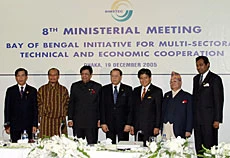
DHAKA, 20 December 2005 — Foreign ministers of seven South and Southeast Asian nations, meeting in Dhaka yesterday to forge greater economic cooperation, agreed they would share intelligence to crack down on terrorism.
The BIMSTEC group, which includes Bangladesh, Bhutan, India, Myanmar, Nepal, Sri Lanka and Thailand, also said it would cooperate in ending sources of funding for terror networks. “We have agreed unanimously to combat terrorism in all our countries,” E. Ahamed, India’s junior foreign minister, told Reuters.
“We have discussed, made assessments and offered proposals,” he said.
BIMSTEC, or the Bay of Bengal Initiative for Multi-Sectoral and Economic Cooperation, gives priority to economic issues and signed a free trade deal in 2004 which is due to be effective from July 2006, officials said. But at this meeting, the meeting discussed terrorism as well, officials said.
“To combat terrorism, a common concern, we have agreed to share intelligence and seal all sources of terror financing,” Bangladesh Foreign Minister M. Morshed Khan told a news briefing.
BIMSTEC nations are set to launch a goods free trade agreement from July 2006, which promises to generate additional trade worth $40 billion, Morshed said.
“We are absolutely hopeful that the BIMSTEC FTA in goods will enter into force from July 2006,” he said after a foreign ministers’ meeting of BIMSTEC.
If the deal comes into full force, it could generate additional trade worth $40 billion to $60 billion among BIMSTEC members, the minister said, quoting from a study conducted by a New Delhi-based think tank. He added that FTA negotiations on services and investments would be concluded later.
The meeting also underscored the need for cooperation in energy and collective action for poverty alleviation, a joint statement said. “To sustain development, our economies must grow together. Our strategies should be aimed at equitable growth. Our motto should be mutual benefit. Our guiding force should be regional solidarity,” Bangladesh Prime Minister Khaleda Zia said while inaugurating the meeting earlier yesterday.
Khaleda called on the seven South and Southeast Asian countries to identify impediments to progress and recommend measures for overcoming the hurdles to ensure equitable growth in the region. She urged the countries to focus on the socio-economic challenges stemming from globalization.
Expressing the hope that BIMSTEC Free Trade Area would be operational from July 1 next year on the conclusion of the Katmandu negotiations scheduled for Dec. 21-27, Khaleda said: “This will be vital to promoting our growing sectors particularly those facing the challenges of globalization.”
The prime minister called for giving priority to social development as she said economic development could not be meaningful without social progress.