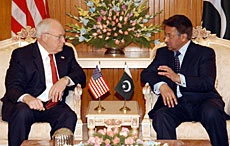
ISLAMABAD, 21 December 2005 — US Vice President Dick Cheney and President Gen. Pervez Musharraf discussed terrorism, Afghanistan, defense cooperation and other regional and international issues.
Cheney conveyed to Musharraf President George W. Bush’s “deep” sorrow and solidarity over October’s catastrophic earthquake that left more than 75,000 dead and displaced 3.5 million others in North West Frontier Province and Azad Kashmir.
“The US was deeply moved at the tragedy and President (Bush) and the American people express deep sorrow over the colossal loss of life and infrastructure,” a Pakistani official quoted Cheney as saying.
In response, President Musharraf thanked Washington for its timely support for the relief efforts in mountainous quake-hit regions.
“Let me express our special gratitude to the United States, all the assistance all along, the commitment of financial assistance, but other than that, the assistance in the relief operation in the form of helicopters, especially,” he said. “I don’t think we could have managed the relief operation without your ships,” he added.
Cheney had to cut short his trip and return to Washington to be available if his vote is needed on legislation moving through Congress, a White House official said.
“He’s needed for close votes,” Cheney adviser Steve Schmidt told reporters traveling with the vice president. “The vice president is returning to Washington to be on hand in the Senate ... to cast tie-breaking votes if necessary.”
After touching down, Cheney boarded a Black Hawk along with Pakistani Foreign Minister Khurshid Mahmud Kasuri to fly to Rawalpindi, where the army is headquartered south of Islamabad, for the meeting with Musharraf at the president’s residence.
The United States has pledged $510 million for relief and reconstruction, including private donations, a US official said. Almost $80 million of that has been disbursed.
The US military has been helping airlift supplies into Pakistan’s northern mountains where the earthquake struck and has 12 helicopters and 900 personnel helping with the relief effort.
Later, cold, cloudy weather and weary quake survivors greeted Cheney as he visited the affected areas.
Cheney flew in to Muzaffarabad, near the quake’s epicenter. People in Muzaffarabad said they were happy Cheney was coming.
Security around key government buildings was tightened, with soldiers and police frisking visitors. Cheney visited a US mobile army surgical hospital (MASH), where American medical teams have been helping survivors since October.
“I’m also, obviously, tremendously impressed with what we’ve been able to do with our MASH unit,” Cheney said. “US forces were able to move quickly ... we were here in 48 hours and we’ve been here ever since.”
It was a measure of the enormous capabilities of the US military to be able to mount a humanitarian mission like this in a moment’s notice,” he said.