
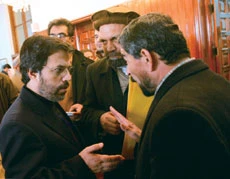
KABUL, 22 December 2005 — Self-styled Afghan opposition leader Yunus Qanuni was elected chairman of the lower house of Parliament yesterday, narrowly beating a former factional leader allied to President Hamid Karzai.
Qanuni, an ethnic Tajik who came a distant second to Karzai in presidential elections last year, was chosen to lead the 249-seat lower house of Parliament with 122 votes against 117 for his closest challenger, Abdul Rabb Rasoul Sayyaf.
“Mr. Qanuni has got the majority of votes and we congratulate him on his victory,” said the interim chairman of the house, Habibullah Ramin, in announcing the result.
The assembly was inaugurated on Monday as part of Afghanistan’s first elected Parliament in more than 30 years.
Sibghatullah Mojadidi, president of the first government of the early 1990s and a close ally of Karzai, was picked to head the 102-seat upper house on Tuesday.
Rumsfeld in Kabul
The US decision to cut its troops in Afghanistan by up to 3,000 will not change its focus on counterterrorism in the country, US Defense Secretary Donald Rumsfeld said here yesterday.
Rumsfeld announced in Washington Tuesday that the United States would reduce its troop strength in Afghanistan next year by between 2,000 and 3,000 soldiers from the current 19,000.
The cut will come as the NATO-led International Security Assistance Force deploys in the insurgency-hit south, where a US-led coalition is hunting down militants from the ousted Taleban regime and Al-Qaeda.
“Of course the United States will be continuing their contribution to NATO ... as well as our individual role with respect to the counterterrorism effort and the training and equipping of the Afghan security forces,” Rumsfeld said.
“We look forward in continuing in those activities and we will continue to be focused on rooting out the Taleban and Al-Qaeda that still exist,” he told reporters.
President Hamid Karzai said Afghanistan was not concerned the troop cut meant a reduction in the US commitment to the country or would hinder its efforts to round up militants. “Afghanistan has the total assurance of the United States that it would remain committed to help Afghanistan in all spheres of life including security,” he said.
“The reduction that the US is intending by next summer doesn’t mean a reduction in the actual force one would need to combat terrorism,” he said.
Meanwhile, Afghanistan’s main rights group demanded yesterday the United States come clean about reported secret detention centers in the country while an Afghan official played down the existence of such facilities.
New York-based Human Rights Watch, citing inmates as sources, said in a report this week that the United States operated a secret prison near the capital Kabul where detainees were abused and tortured as recently as 2004. The watchdog’s Asia research director Sam Zarifi told AFP at the weekend that US forces were indefinitely detaining and mistreating people without charge at various undisclosed bases around the country.
US Defense Secretary Donald Rumsfeld was asked about the allegations at a media briefing in Kabul yesterday with President Hamid Karzai, who, after translating the question for him, said: “I am sure you don’t have them, say you don’t have them.”
“If I had, then they would be secret,” Rumsfeld replied. The Afghanistan Independent Human Rights Commission said the allegations were credible and shocking.
“The revelation of secret detention centers is very shocking and concerning,” commissioner and spokesman Nader Nadery said.
“We demand the Afghan government and US-led coalition force make public the name and locations of these detention facilities,” he said.

