
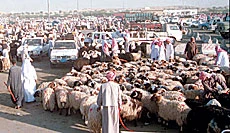
RIYADH, 10 January 2006 — Thousands of people flocked to the sprawling sheep market and thus began a price war among the sellers. The sheep market in the south of Riyadh was packed with hundreds of pick-ups carrying Naimi and Najdi sheep, among other varieties.
Some Saudi women were present in cars as their men haggled over prices.
Although the prices remained more or less at the same level as last year, Abdullah Al-Otaibi, a sheep-owner from Thumair, 250 km from Riyadh, said that there had been a slight price fall in what was essentially a buyer’s market. The sheep prices were from SR500 to SR1,200, depending on the size and variety of the animal.
He said the going price for the locally-bred Naimi was SR900 as opposed to SR500-SR700 for a similar variety from Syria. The difference in price was attributed to the animal’s diet. While the local variety was fed on fresh fodder and other nutrients, the Syrian ones were fattened on a diet of genetically modified food, Arab News was told.
There was no sign of veterinary inspectors from the Ministry of Agriculture to check the health of the animals. However, enquiries with sheep owners revealed it is normally in slaughter houses that the inspectors do their jobs. Asked what would happen if any animal were found to be infected, one vendor said it would be sold at a discount to an unwary customer. Another nearby pointed out that it would be wrong to generalize about such malpractice.
Bangladeshis and Pakistanis standing outside the municipal slaughterhouse near the sheep market had a busy time. Armed with sharp knives, they approached buyers of sheep and offered their services — in this case, slaughtering, skinning and bagging the animal for a fee of SR100.

