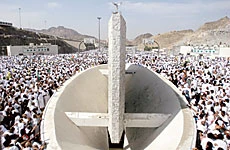
MINA, 11 January 2006 — Tens of thousands of pilgrims yesterday hurled pebbles at the Jamrat Al-Aqaba, one of the three walls representing Satan.
The ritual was conducted in a very organized manner in this tent city. All previous tragedies occurred during this ritual.
This year the Saudi government showed how organization and logistic support can save human lives. Gen. Marwan Al-Sobhi, the head of the Emergency Special Forces, said there were 10,000 soldiers for organizing the movement and flow of the pilgrims at the Jamrat Bridge, where the three walls are located.
The ritual took place with military precision. Lines of police directed the crowds. A fleet of ambulances was lined up nearby but there was little need for their services. Too often the pilgrims did not help themselves in the ritual.
Many still insisted on toting large bundles and bags to the stoning area despite being instructed not to do so.
A very relieved Dr. Hamad Al-Manie, the health minister, told Arab News that the Jamrat ritual went off without a hitch.
“There were, by the grace of God, no injuries and no deaths as more than 2 million pilgrims performed the stoning of the devil ritual,” said Manie. “It is an achievement that the whole exercise went off in a much, much better way than last time. We always try to achieve the best possible results. This will not stop us from further streamlining and improving health services in the future.”
The minister also said that there have been no reported cases of serious contagious diseases or outbreak of epidemics.
Pilgrims were frantically throwing pebbles at Satan with disdain very much evident on their faces. A tide of white-robed faithful had gathered around the site from early morning. Carrying their pebbles, no bigger than a bean, in plastic bags or small empty water bottles, the pilgrims chanted “Allah-o-Akbar” as they threw each pebble.
Relatives threw protective rings around women and the elderly to prevent them from falling or being shoved.
Makkah Governor Prince Abdul Majeed said the movement of pilgrims from Muzdalifah to Mina was smooth and accident free in the morning. Some 15,000 buses were deployed to transport the pilgrims.
The General Statistics Department of the Economy and Planning Ministry put the total number of pilgrims this year at 2,130,594. Of them, 1,557,447 came from abroad while 573,147 performed Haj from inside the Kingdom. Most of the pilgrims from inside the Kingdom were non-Saudis.
Yesterday also marked the start of Eid Al-Adha, the feast of the sacrifice, which recalls Prophet Abraham’s readiness to sacrifice his son as God tested his faith. At the last moment, God substituted a sheep for the son, Ismael.
Municipal authorities at the holy sites prepared slaughterhouses to cope with the rush. There are three main slaughterhouses in Mina for sacrificing sheep. This year the municipality added a fourth for sacrificing camels and cows.
Returning from the stoning, the pilgrims looked extremely pleased. The act itself seemed to have a great cathartic effect. After the stoning, those who had not deputized others to perform the sacrifice on their behalf proceeded to the abattoirs. Others went to have their heads shaved.
At the abattoirs, the poor congregated to take away their share of the sacrificial meat. There was also a long line of refrigerated trucks.
Before returning to Mina from Arafat, the pilgrims spent the night in the plain of Muzdalifah where they collected pebbles for the stoning ritual.
After completing the rituals of the day, thousands of pilgrims lined up to phone home. “The pilgrimage has gone much easier than I expected,” said Shahnawaz Ahmad, a 36-year-old Indian from Calcutta.
Sabeel Norani, another pilgrim from India, praised the improved arrangement at the Jamrat that has made it easier for pilgrims to do the stoning.
“Everything went according to plan and, by the grace of Allah, we have had no untoward incident at the Jamrat,” said Ibrahim Sulaiman, a Syrian.
“I finished the stoning ritual in less than 15 minutes,” Jalal Abdel Fattah, an Egyptian, proudly said.
“It was a piece of cake this year,” said Suleiman Fallatah, 26, a Saudi native of Makkah, as a barber shaved his head with a razor.
The shaving or shortening of hair by male pilgrims is the first step of ending their state of ihram, or sacred dedication, which they entered into before the Haj started Sunday.
Fallatah who has performed the annual pilgrimage 10 times was to head next to Makkah to perform another key rite, Tawaf Al-Ifadah which involves circling the Kaaba in the center of the Grand Mosque.
Pilgrims will mass again at the Jamrat Bridge today, this time to stone all three walls representing Satan.
— With input from Siraj Wahab, Syed Faisal Ali, Hasan Hatrash and Wael Mahdi