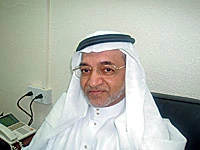
MINA, 12 January 2006 — Adnan Muhammad Amin Kateb, chairman of the board of South Asian Pilgrim Establishment, is a soft-spoken person. He is also very busy. The organization that he heads is responsible for the arrangements of hundreds and thousands of pilgrims.
“Every year is a challenge,” he told Arab News in his makeshift office in Mina. “For the first time our establishment employed women pilgrim guides. They were tasked with providing health care and other support services to women pilgrims. The experiment was very successful, Mashallah, and we hope to continue it next year as well.”
“The women guides did a tremendous job. They visited the sick pilgrims in hospitals. They provided them with moral support and distributed gifts among them with a view to cheering them up and to lifting their spirits. We hope to increase the role of this team in the future by extending their activities in the service departments of the establishment in Makkah and other holy sites,” Kateb said.
He said pilgrims coming from South Asia were now being given extensive training at Haj orientation camps in their respective countries.
“A serious thought to the training aspect of pilgrims was given after the Kuala Lumpur convention several years ago. The results are there for everybody to see. The successful organization of Haj 2006 is proof of the fact that training is having its effect. Pilgrims from India and Pakistan who form the bulk of our guests are more aware of the Haj rituals now than in the past. They undergo intensive training in their countries about what to do when they are in Makkah, Mina and Arafat. This has eased a lot of pressure on security organizations,” he said.
“Our establishment has its own awareness programs for pilgrims before they arrive in Mina and Arafat. We have a special team that educates pilgrims by gathering them in open areas and giving them instructions about how to perform the stoning of the devil ritual and about the right ways of performing other rituals. In addition, the team distributes books and publications in various languages on various aspects of Haj. The awareness campaign is going great guns but still a lot needs to be done. We need to improve and maintain consistency,” Kateb said.
About the accommodation problem in Makkah, Kateb said: “The increase in the number of pilgrims and the limitation of housing in the central area of Makkah led some establishments to set up accommodation in places far away from the central area but they have sufficient transport to take them to the holy mosque. With the huge construction activity that is going on in the holy city, this has become the necessity. Even with all the expansion, there would still be proper transportation to serve all the pilgrims whether they live close or far away from the holy mosque,” he said.
Kateb said Haj 1426 (2006) was successful “because of the grace of God and the countless efforts of Haj Minister Fouad Al-Farsy. The scientific and accurate implementation of all the basic plans greatly contributed to the smooth flow of pilgrims first from Makkah to Mina, then from Mina to Arafat and from Arafat to Muzdalifah and back to Mina. The Haj minister was in constant touch with all the relevant agencies and was constantly and continuously following up on the plan’s implementation.”
A board of 12 members heads the establishment. There is the parent establishment that works around the year with 30 officials. The establishment has field service offices that offer direct services to pilgrims. Each office serves around 5,000 pilgrims.
“We have 81 offices to serve pilgrims this year,” Kateb said. “There are seasonal committees with 1,000 Saudi employees that operate various services including reception, transport, housing and general supervision.”
For Adnan Kateb, the Haj of 1997 will remain etched in his memory forever.
“That was the year when a ferocious fire reduced more than 20,000 tents to ashes. It was a difficult year. We faced many crises because of the fire accident. After that year, we had these new fire-resistant tents. It led to the complete elimination of fire in Mina for good. Alhamdulillah,” he said.
“We want to express our sincere thanks to Custodian of the Two Holy Mosques King Abdullah, Crown Prince Sultan and the Haj minister and all the government agencies and the respective missions of the South Asian countries for their support and facilities. Haj mabroor,” Kateb said.