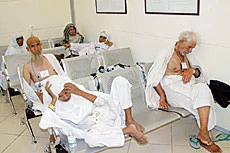
MINA, 12 January 2006 — Things started out well, but the number of missing pilgrims increased sharply by the third day of Haj, authorities in charge of tracking missing persons said yesterday.
An official at the Saudi Boy Scouts, the organization that works in tandem with the Haj Ministry to find missing persons and track statistics, told Arab News that by yesterday there were 30 percent more missing persons than registered during the entire Haj period last year.
There was a marked increase in reports of missing pilgrims on the day of Eid and the stoning at Jamrat, said Shaker Radain, the head of census, guidance and computer systems at the Saudi Scouts’ information center in Mina.
Last year, the total number of pilgrims reported missing was 17,000; the number this year is 21,000 so far, according to Radain, who points out that the day of Eid is always when reports of lost pilgrims reach its peak. In fact, the first two days of Haj saw a great reduction in the number of lost pilgrims compared to last year, thanks to increased organization and visual aids for lost pilgrims.
A majority of the lost pilgrims are usually from India, Turkey and African countries, according to Haj Ministry statistics. This year, however, the number of lost Arab pilgrims increased substantially, about 10,000 in the first three days.
“We logged 3,000 reports of lost pilgrims in our computer systems in the first six hours of the stoning period alone,” said Radain. “This increase surprised us, considering that our preparation has been excellent. We added many services for the first time to help the pilgrims get back to their camps.”
Most lost pilgrims are eventually reunited with their groups, either on their own recognizance or with the help of the Boy Scouts or local officials in charge of crowd control.
“The problem starts after they finish stoning,” said Radain, “because while they are stoning they focus on stoning itself and forget about the group, and when they are finished they start looking for each other, often in vain.”
Mina is a very small area, nevertheless people can get lost easily. One reason is that all camps look similar. There are also many squatters lying down on the streets with their personal belongings thus blocking the main entrances and exits of Haj camps and sidewalks, creating confusion.
Sami Siraj Mulla, a supervisor at a Haj Ministry help center, told Arab News that another main cause for the loss of pilgrims is the lack of supervision from pilgrim establishments (mutawwifs) over their assigned pilgrims.
Furthermore, Mulla said that the ministry established the lost pilgrims guidance centers to help pilgrims who are staying with specific groups in designated camps, “but if the pilgrim is staying nowhere in the street and he is lost we cannot take him to his group or place.”
According to Mulla, another major obstacle that prevents them from delivering the pilgrims successfully is the absence of proper identification with the pilgrims.
“The campaign management should issue cards and bracelets that carry the information of the pilgrim along with the camp location on it. Without this it is difficult for us to guide the pilgrims,” said Mulla.
The ministry added two new help centers this year, putting the total to 20. This year the ministry added a creative directional map (called the self-guiding map) that will allow any pilgrim who is capable of reading to reach any location in the holy sites. There are also many directional signs and wall maps posted in many places to guide pilgrims.