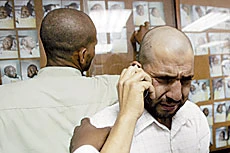
MINA, 14 January 2006 — Each photo has a number. A grieving relative notes this number and gives it to hospital staff in order to see a corpse.
This process was repeated hundreds of times at the Muaisem Emergency Medical Center near Mina yesterday.
About 100 people were seen by Arab News frantically scanning the 300 or so photos in a room near the hospital’s morgue where hundreds of victims of Thursday’s tragic stampede waited to be claimed. In one corner a television played a video loop of the same pictures.
Occasionally, somebody would cry out, having found a picture of their missing loved one. Others left the room relieved that their friends or relatives remained missing but probably alive somewhere.
Altafur Rehman, from Varansi, India, broke down in tears as he found his wife among the macabre collage of mangled and bruised faces. “I am in extreme pain and disbelief that my wife fell down before my eyes and I could not help her,” said Rehman. “I am unable now to go back to face my 10 children waiting for their mother back at home.”
Pakistani national Hamid-u-Din was seen chasing after a stretcher carrying the body of his sister Haleema as it was taken into the refrigerated morgue. He yelled with frustration regarding how to claim the body.
“I want to send the body back to Pakistan, but I have no idea about the formalities involved,” he said in tears.
Hamid complained bitterly that the stampede would have been avoided if the squatters weren’t allowed to sit on the pavement crowding the entry points to the Jamrat Bridge.
At the very moment Mohammed Sareeduddin was speaking to Arab News, he seemed to be shifting from disbelief to acceptance of the death of his uncle, Mohammad Bahauddin of Hyderabad, India.
“The picture of my uncle is there, but the body is so badly damaged that I am still hopeful that it is not my uncle. The face is unrecognizable,” said Sareed. “I am keeping hope that he is still alive. And that is why I want to see the body.”
Then, as quickly as he expressed his desperate hope, Sareed began looking for someone to let him into the morgue to see the body and give him further instructions. Saddened by this acceptance, Sareed consoled himself by saying that it was Allah’s will, and that Allah will accept his uncle’s pilgrimage and grant him a place in paradise.
Confusion persisted among some grieving pilgrims who did not speak Arabic. Despite the best intentions of hospital staffers, the process of getting information and identifying bodies confounded many.
About 50 to 70 people gathered at the doors of the morgue, hoping for a peek inside, anxious to finalize their worst fears by seeing for themselves the bodies.
Bassam Mohammad, a Saudi, told Arab News that he and his group of 20 to 25 had lost three of their friends and relatives in the stampede.
“We are here to identify three bodies and do the formalities to take possession of them,” said Mohammad. “Nothing can happen in the world without Allah’s will. Whatever happened yesterday was Allah’s will. We should not cry and yell, instead we should pray for the peace and salvation of the dead.”
Mohammad Othman, a Sudanese, was there to find out about the fate of his friend’s wife, saying that his friend fainted in the stampede and was recuperating in another hospital in Mina. “Thank God at least my friend is alive to take care of his family back in Sudan,” said Othman. “My friend’s wife has come to perform Haj and go back to her country, but she was destined to die in Mina.”
A man deeply in grief and sorrow sitting in the corridor of the hospital, who identified himself only as Ahmad from Allahabad, India, said he lost his friend Mohammad Alam Siddiqui, 32, and his mother Shaheeda Begum, 56. Shaheeda’s husband survived.
“Alam’s father escaped unhurt and has reached Makkah. I have informed him about the death of his son and wife. I don’t know how he’s coping with the situation alone in Makkah,” said Ahmad.
Outside, ambulances continued to arrive with bodies among a crowd of people waiting for news of their missing loved ones. With heavy hearts, people loaded the bodies of local residents who were taken away for burial.